Author Archives: Sarah Marley

Fieldwork Update: Watch out dolphins, Big Sister is watching (and listening!)

Over the last couple of months I have had a busy whirlwind of deploying noise loggers; learning how to program recording schedules and then process acoustic data; complete health and safety forms; obtain permits for area use; train volunteers for visual surveys; organise fieldwork shifts…  and this is before the fieldwork has even started!  But now it’s all underway and the data is coming in!

Eavesdropping on Dolphins…

Sylvia and Mal from CMST head out into the Swan River to help deploy my first batch of noise loggers

Sylvia and Mal (CMST) head out into the Swan River to help deploy loggers

Back in November 2013, three noise loggers were deployed in the Swan River as part of my PhD project examining the acoustical and behavioural response of coastal dolphins to noisy environments.   I have been lucky enough to have great support from the students and staff at CMST to help me with deployments.  Now the first batch of acoustic data from this first logger deployment is in my office, ready for processing!

These noise loggers record underwater sound produced by ambient (wind, waves), biological (dolphins, fish, crustaceans), and human sources (vessels, traffic, and construction).  For more info on these noise loggers, see my previous post on recording whale sounds in Albany.  Whilst I am examining this first acoustic data batch, the noise loggers have been moved to new locations and are busy recording more underwater sounds.

Over the next year, I will be deploying noise loggers at several spots throughout the river.  I can then use these data to describe the underwater soundscape of the Swan River and examine the vocal behaviour of bottlenose dolphins.

…  Whilst Watching from Above!

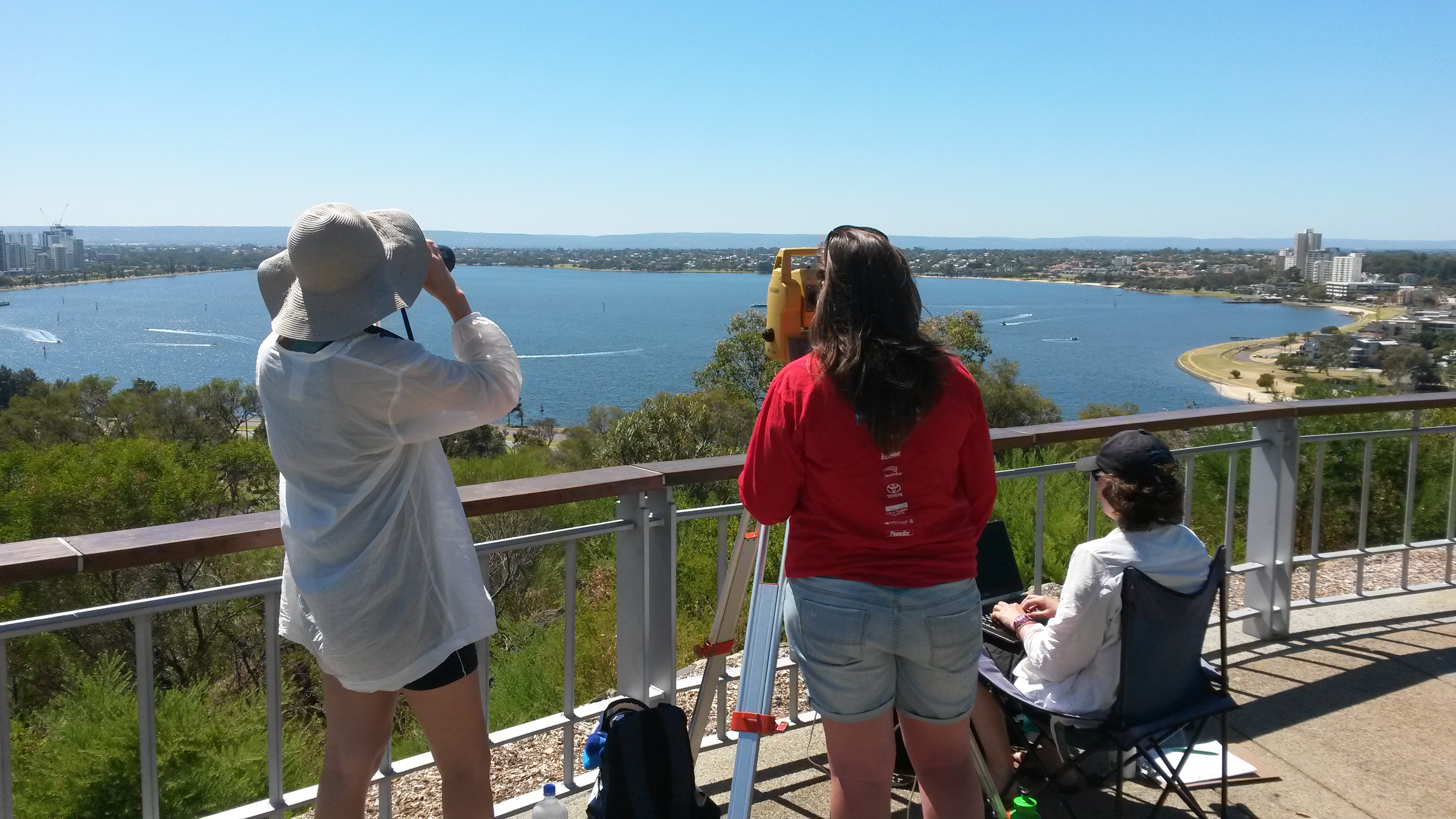
Visual observations of dolphin behaviour began in January 2014.  I am conducting visual surveys at various vantage points along the shoreline, using a theodolite to record dolphin movements and behaviours in the river.  This visual information can then be used to understand the context of dolphin sounds and their use of the underwater acoustic environment.

A theodolite is traditionally a surveying instrument, used to create 3D models of the landscape.  It does this by selecting different points, then measuring the horizontal and vertical angles to give an exact bearing and distance to each point; this creates a scale map of the area.  But we can also use this technique to get the position of objects out at sea – such as dolphins!  So we can use a theodolite to map a dolphin’s position each time it surfaces, giving a very fine-scale track of how the animals are using an area.  The added bonus being that the dolphins are not aware of our presence, so we do not have to worry about disturbing the animals and influencing their behaviour.  Although I do often wonder if they have a “feeling of being watched”…

Volunteers Elly and Bec join me surveying for dolphins in the Swan River

Volunteers Elly and Bec join me (and theo) surveying for dolphins in the Swan River

To run these visual surveys, I require a theodolite team:  one person entering data on the computer, one collecting positions using the theodolite, and some others to find the dolphins!  Thankfully, I have had an overwhelming amount of support from my ex-students (and some marine biologist friends), and currently have around 25 volunteers donating their time to help out in the field.  Many are studying or working full-time, making their contributions all the more amazing and appreciated!

But we have had some particularly awesome dolphin sightings to make it all worthwhile – and even on quiet days, the great team spirit (and masses of life stories to tell) keeps us pretty entertained!

The Death of Conservation

Last month was the 19-year anniversary of the death of my greatest conservation heroes.  He fought for change – in the purpose of zoos, the role of scientists, the preservation of species and their habitats, and ultimately the attitude of people towards nature. But does public opinion still uphold such beliefs, or is support of conservation slipping?  And more importantly – particularly given recent events in Australia – will governments still fight to protect our environment?

Previously, zoo conditions were often nothing better than animal pits (Photo: Tampa Bay Times)

Early zoo conditions were often just animal pits (Photo: Tampa Bay Times)

Changing the Purpose of Captivity

Gerald Durrell was born in 1925 and quickly developed an obsession with the natural world.  His first word was “zoo” and as a toddler he demanded to be taken on daily trips to the local menagerie.  The primary purpose of zoos in those days was entertainment, with most establishments aiming to give the public a close-up view of charismatic fauna like lions, elephants and monkeys.  Unfortunately, the conditions these animals were living in were close to squalor, with more emphasis being placed on a good view than animal welfare.  Furthermore, due to their poor conditions, few of these captive animals successfully bred and so upon their (usually early) deaths they were replaced from wild populations.  This animal collecting, combined with hunting, habitat destruction, and an increased distribution of human activities, caused many wild populations to dramatically decline.

But to Gerald Durrell, the purpose of a zoo was more important than entertainment – it was an opportunity to educate the public, contribute to scientific knowledge, and create captive breeding stocks of threatened species.  His was not a zoo full of lions and tigers – it acted as a safe haven for little-regarded, yet critically endangered, species such as the Madagascan aye-aye, Mauritius kestrel, and Haitian giant gulliwasp lizard.  Thanks to his captive breeding and re-introduction programs, Durrell was able to regenerate wild populations of these species and many more.  He went on to become a world-renowned naturalist, conservationist, author and television presenter.  But his living legacy exists in the Durrell Wildlife Conservation Trust, which promotes the captive breeding and re-introduction of threatened species as well as protection of their natural habitats.  The Trust also assists with the education and training of local people in communities home to these endangered species, ensuring that they have the means to protect their native fauna and flora well into the future.

A New Generation of Conservationists

The creation of the Trust coincided with a time when public feeling regarding the natural environment was changing.  The 19th Century had been a time of increasing interest in nature and scientific thinking, with several animal welfare groups being founded towards the end of the 1800s in addition to governmental departments for forestry and land management.  The idea was slowly rising that humans had a duty to protect natural resources for future generations.

The Durrell Wildlife Preservation Trust has already trained up 3,350 conservationists from 135 countries to ensure local hands-on involvement in conservation issues

The Durrell Trust has already trained up 3,350 conservationists from 135 countries.

By the 1900s, efforts arose targeting individual species for protection leading to a global awareness of conservation biology.  The decline of wild populations was being widely noted, leading the public to rise up and demand protection for wild animal populations.  Popular examples include protests to ban whaling, save mountain gorillas, and stop the hunting of big cats.  Not only was the public taking an interest in wildlife management, but in many cases they were actively protesting and fighting for the legal protection of threatened species.

Soon the idea began to spread that to protect a species you must also protect its habitat.  The work of the likes of Gerald Durrell, in establishing successful captive breeding programs, was pointless if there was nowhere to re-introduce the animals to.  And so the focus changed to creating and maintaining national parks, sanctuary zones, and other protected areas to guard both animals and their habitats.  As this need for “green space” increased and conflicted with “human space”, many groups of people began changing their habits to reduce impact on the environment.  The idea of “reduce, reuse, recycle” became widely advertised, along with eco-versions of many products.  The pressure was on society and companies to prove how green they could be.

Current Conservation Issues in Australia

Yet, at the same time, while many people continue to “do their bit” and minimise their environmental impact, others have grown complacent.  If so much is already being done, does it really matter if they slack off?  With so many protected forests, can’t they afford to take a bit more?  With so many increasing animal populations, can’t they just hunt or fish a bit more?  Everyone has done so much for the environment already, isn’t it okay to mold it to human-uses?

The last six months has seen a disturbing increase in such thinking in Australia, to the point that some are wondering whether the current government is the most hostile to the nation’s environment in history.  In Western Australia, endangered sharks are being culled.  In Queensland, the world-famous Great Barrier Reef is under threat from the dumping of dredge spoil.  In Tasmania, World Heritage listed rainforest is to be opened up to commercial logging.  Around Australia, the marine reserve network – which, when announced, was to be the biggest in the world – has been scrapped.

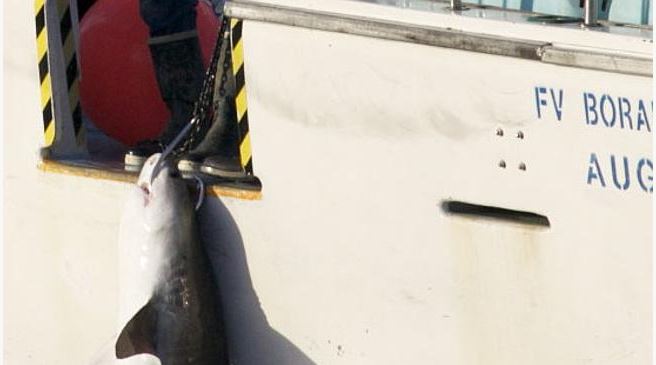
The shark cull involves setting baited-drum lines along the WA coast near popular beaches, with the aim of catching great white, tiger and bull sharks over 3m long.  The lines are checked regularly, and any sharks above the size limit are shot; smaller sharks are released.  Unfortunately, of the 66 sharks caught in drum-lines since 1st Feb, 50 have been undersized.  Of these, 40 were released – but due to injuries sustained from bait hooks, it is uncertain how many released sharks would actually survive.  There is also the risk that drum-lines will catch other animals, such as dolphins, turtles and non-target shark species.  Worst of all is the fact that other studies indicate that drum-lines will not reduce shark attack rates, and suggest that there are various other methods better suited to reducing the risk of human-shark interactions.  With a range of other (research-supported) options available, it is not necessary to jump to the “shoot-it-in-the-head” method.

The survival rate of hooked undersized sharks is uncertain, with some sustaining large injuries

The survival rate of hooked undersized sharks is uncertain, with some sustaining large injuries (Photo:  PerthNow.com.au)

Before you can control any wild animal, you have to know something about its basic biology; a simple policy of slaughter – quite apart from its threat to the survival of that particular species – is liable to do untold damage to the whole ecological structure of the country.  An unbiological approach in different parts of the world to problems of this sort have, in the past, proved disastrous.  So if an animal is becoming a pest you must set out to learn everything you can about it; it is a case of ‘knowing thine enemy‘” says Gerald Durrell decades ago.  But it looks like these words are no less needed or true today.

On the other side of the country, the Great Barrier Reef Marine Park Authority has approved plans to dump 3 million cubic meters of dredge spoil within the marine park area to allow expansion of a coal-export port.  Such sediment from dredging has been previously shown to damage coral and seagrasses by smothering them and causing exposure to poisons and elevated nutrients.  This comes shortly after the new government’s decision to suspend Australia’s Marine Reserve Network and change management plans to allow access to these marine areas by recreational fishers.

Meanwhile, back on land, the Federal Government has made a bid to open Tasmania’s World Heritage forests to logging.  After decades of fierce debate between forestry and conservation groups, an additional 170,000 hectares became protected as part of a “peace deal”.  The logging bid would see over half of this opened for commercial use, with the government arguing that the area in question is already degraded due to previous logging.  Yet World Heritage experts claim 90% of it is pristine forest.  Even the Tasmanian timber industry opposes this move to de-list the forest.

Durrell wrote many novels detailing his childhood as an amateur naturalist, early career as a zookeeper and animal collector, and later years working in conservation.  His book “Two in the Bush” describes a visit to Australia, New Zealand and Malaysia in the 1960s, in which he becomes enraptured by the land downunder:

We all fell in love with Australia completely and instantly.  If ever I was compelled to settle down in one spot – which God forbid – Australia is one of the few countries I have visited that I could choose

I wonder if that would still hold true today?

Discipline with a Deadline

The need for ongoing conservation is obvious.  But is the public willing to rise up in aid of these issues?  Thankfully,  the overwhelming answer appears to be ‘yes’.

Over 6,000 people attended just one anti-cull shark rally in WA

Over 6,000 people attended just one anti-cull shark rally in WA (Photo: bbc.co.uk)

Public protests and social media petitions against the WA shark cull have seen over 6,000 people gather on one Perth beach alone.  Support has also sprung up in the form of additional protests around the world, with the public of New Zealand, South Africa, UK, USA, Spain, and so many others uniting against the cull.  Online petitions against damaging our Heritage-Listed rainforests and coral reefs are also spreading through the wonders of social media, as are messages from groups fighting for the re-instatement of Australian marine parks.

Conservation biology is often referred to as the “discipline with a deadline”, emphasising the importance of immediate action to help species reduced to a few dozen individuals or habitats shrinking in size each day.  It does not necessitate the end of modern living and everyday convenience – just a revision of old ways of thinking.  Every little helps.  As Durrell points out in his ‘Two in the Bush’ novel:

You cannot, of course, halt progress, but is it necessary to destroy everything in your path to achieve it?

As long as we continue to think about the world around us and voice our concerns, we have the chance to make a difference.  But the remaining question is: will anyone in authority listen?
Top 5 PhD New Year’s Resolutions

Academia can seem pretty tough-going at times.  In a field where everyone is striving to publish the most papers and get the most funding, but where most people are limited by time and opportunities, things can get a bit competitive.  So acknowledging your weaknesses just is not done, especially weaknesses connected to your work.

But in order to turn those weaknesses into strengths, you have to know where to start!  So to that end, here are some of my  New Year’s resolutions to work on over the next few months.  Obviously there are so many more things I can improve upon (eat healthily, call home more, go to the gym, break up with Facebook).  So these five are focused primarily on balancing PhD life.

1. Learn that it is okay to read

Good research requires a good knowledge of the subject, and this can only be achieved by searching the literature and reading,reading, reading!  But the problem with sitting reading papers at your desk all day is that you don’t have any solid outcome to show for it at the end of the day (apart from maybe eye strain and a headache).

I struggle with this lack of physical result, as it sometimes makes me feel like I’ve not been very productive by ‘just’ reading papers.  So something I aim to work on next year is to set aside time each week specifically for reading and updating Endnote.  To make it seem more productive, I’ll work on my note-taking skills – this will have the double benefit of making me feel like I’ve achieved something whilst also giving me some good quick-reference material for later.

2. Get at least 7hrs sleep each night

First step to getting more sleep - bean bag nap area under desk.  Win!

First step to getting more sleep – bean bag nap area under desk. Win!

Chronic sleep deprivation is not going to help you achieve anything.  Yes, you might have to pull some late-nighters to get that grant application in, or get up at ridiculous o’clock to reach your field site.  But that doesn’t mean that you have to sacrifice sleep to do so.

It is okay to sleep in a bit later if you had to work late.  It is okay to be a granny and head to bed early if you’re up at day-break.  Need a power nap mid-avro?  Go for it!  If you’re up to date on sleep you will work a hell of a lot more effectively than someone holding their eyes open and forcing every sentence into Word.  I’m aiming to be a lot stricter (and realistic) with sleep patterns, especially as I tend to get migraines after missing a few sleeps in a row – which knocks me out for a lot longer than a lie-in would.

3. Publish

The must-have on every academics to-do list:  Publish more papers! There is a strong idea of “publish or perish”, and while this might be a bit dramatic it is probably true that you will have a better chance of succeeding with scholarships, job applications and grant funding if you can add up points in the ‘papers published’ box.  When I ask Post-Docs if they have any advice for an early-days PhD student, the recurring comment is to get multiple papers out during the PhD.

I just got around to publishing my honours thesis on bottlenose dolphin aggression this year, have a co-authored paper on whale acoustics in review, and still have material from my masters on grey seal behaviour which needs to be put into paper format.  So a big aim for next year is to finish that task, as well as publish something PhD-related.

4. Overcome the phone addiction

Smartphones are amazing.  I use mine for work a lot – especially during field work, it is very useful to be able to check emails on the go and arrange meetings without being tied to a desk.  But is there really a need for checking work emails every evening?  If you’re always online then you are always on duty.  Not conducive to the increase in sleep or quality time that most people would like in their lives.

A lot of the time I don’t mean to do this, but as I use my phone to tell the time I often see notifications about missed calls or unread emails and get sucked back into work mode without really realising it.  So the most obvious way around this would be to start wearing a watch more so I can give myself the opportunity to forget about the phone.  I’m also going to enforce a stricter ‘silent mode’ rule during quality time with boyfriend and mates in the evenings.  Feel free to give me in trouble if you see me violating this one, because it’s bound to happen!

5. Spend time with people outside of my university circle

It's important not to shut out friends during your PhD...

It’s important not to shut out friends during your PhD…

As much as you may love your office mates, it’s still important to step outside of the circle once in a while.  Because inevitably the conversation will at some point touch on work – be it project stress, supervisor management, paper writing, or “Did you hear about this grant?” type topics.  Sometimes it’s good to forget about work for a while!

Before I started my PhD, I spent a year volunteering on projects around Australia and two years working as a science communicator.  During this time I met lots of interesting, crazy, lovely people – most of whom I haven’t seen much, if at all, in the last six months, i.e. since the PhD began.  Granted I’ve been away assisting on field projects and travelling, but since I have no plans to leave Perth in the next few months this is the perfect time to re-affirm friendships and start catching-up!  But of course I’ll still have time for my university family 😉

Humpbacks, Hills and Hobbits – a summary of the last three months

I realised it had been a long time since my last blog post, but I’d forgotten that the last you’d heard from me was some comments about my dubious sea survival skills.  On reflection this might have been a bit ominous when followed by a three month silence, but rest assured I’m still here!  And I have so much to tell you!  Too much, in fact, for one post – so to avoid the risk of boring you, I’m going to give a brief summary now with more details to follow over the Christmas break 🙂

Early Sept – Mid Oct:  BRAHSS Project (Dongara, Western Australia)

Heading out from Dongara for another day of whale research!

Heading out from Dongara for another day of whale research!

Six weeks working as a marine mammal observer on the BRAHSS project, investigating the response of humpback whales to seismic surveys.  Although bouncing around in big swells off the coast of Western Australia was quite fun, it was really great to meet so many researchers from around Australia.  Since this project involves people from Curtin University, University of Queensland, and the University of Sydney there were plenty of new friends to be made!

Prior BRAHSS field seasons were conducted in Peregian Beach on the Sunshine Coast, so 2013 marked the first experimental period for Western Australian.  Fine-scale behavioural data were collected during control and active trials, thus detailing the responses of humpback whales to air-gun signals.  This work will be compared with data collected on the eastern Australian humpback whales, thus allowing comparison of different populations with different seismic exposure histories.

Mid Oct – Early Nov:  Doing a PhD! (Perth, Western Australia)

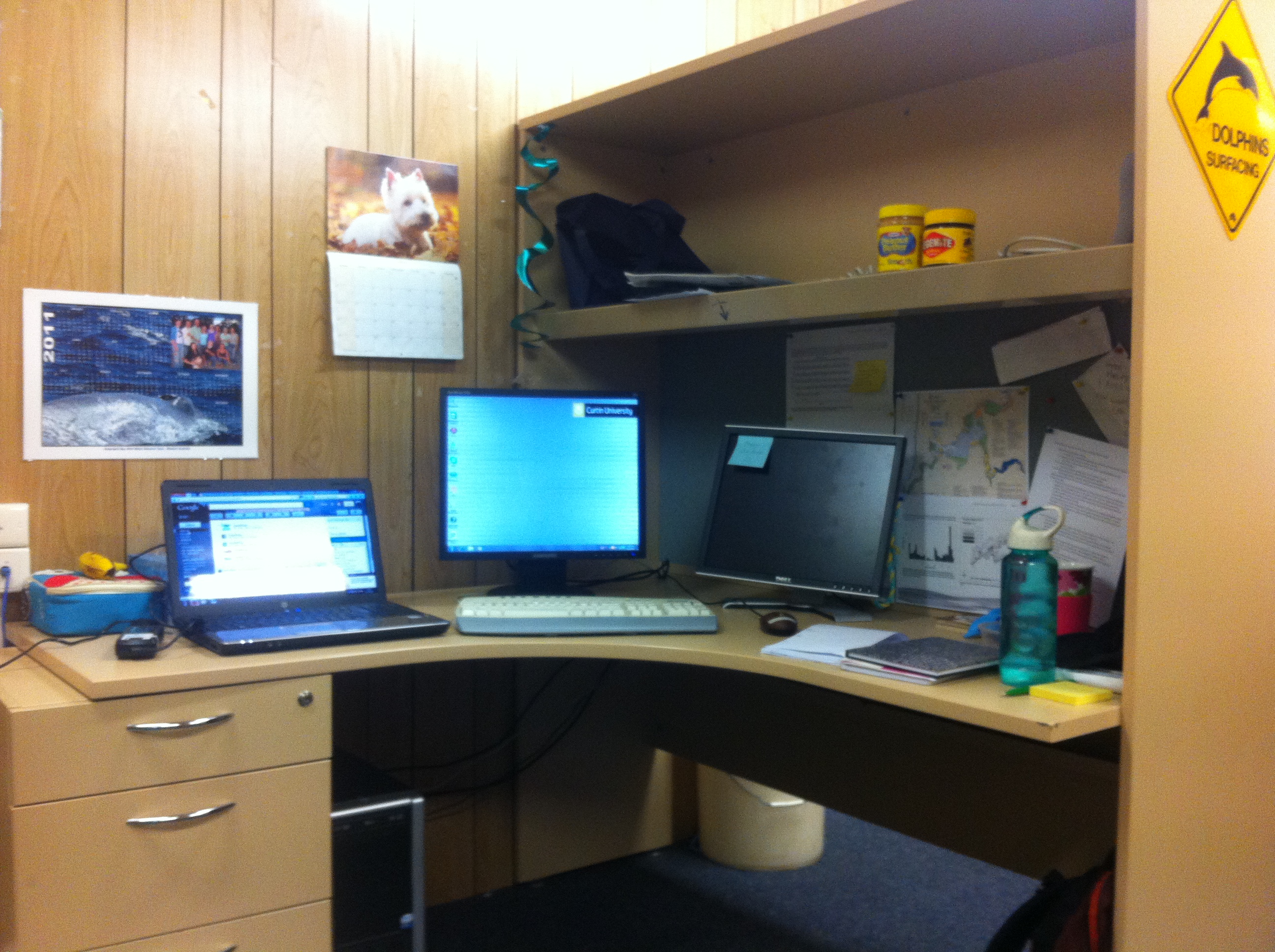
My desk of PhD awesomeness!

My desk of PhD awesomeness!

Nice to be home for a bit!  These few weeks gave me time to get-to-grips with my PhD and make progress with my application for candidacy.  Within the first six months of the PhD, students are required to submit a 10-page research proposal detailing their intended project.

So over these few weeks I did a LOT of reading through the scientific literature and swotting up on acoustics!  I was lucky enough to spend some time with the CMST technician Dave who gave me instruction in preparing the noise loggers, programming the recording software, and general electronics!  I also got lessons in splicing and mooring design thanks to Miles and Mal, more important skills that I’ll need for deploying my own loggers over the next few years!

This period also marked a move, as I shifted from the main physics building at Curtin University to the physics student building out the back.  Although it’s strange to be away from the staff, it does mean that I get my own big fancy schmancy desk and computer!  Woop woop!  Now to decorate it with as many dolphin pictures as possible…

Most of Nov:  SouWEST Project (Geographe Bay, Western Australia)

Blue waters and blue whales for the Geographe Bay 2013 theodolite team!

Blue waters and blue whales for the Geographe Bay 2013 theodolite team!

A sudden flurry of activity to organise the theodolite and acoustic components of the Southwest Whale Ecology Study (SouWEST) project for the 2013 field season.  I headed down to Geographe Bay with Chandra, Angela and Damien to continue our blue and humpback whale monitoring program which has now completed its fourth season!

I’m very proud to have been part of this project since 2010 when I helped Chandra with the first theodolite monitoring from our hill-top site near Dunsborough.  From here we can track the whales in real-time as they move through the area, and also record their behaviours and pod compositions.  Combined with the acoustic monitoring, boat surveys with photo-ID and community-based observations, these data give us a thorough view of how whales are using the Geographe Bay region.  This year was particularly exciting, as we deployed an array of four noise loggers – having multiple hydrophones will allow us to triangulate the positions of calling whales, and track them acoustically! It is also our first year with funding from the International Fund for Animal Welfare (IFAW) to support the SouWEST project.  Check out my post on the SouWEST blog to read more about our season!

Late Nov – Mid Dec:  Holidays and Conference! (New Zealand)

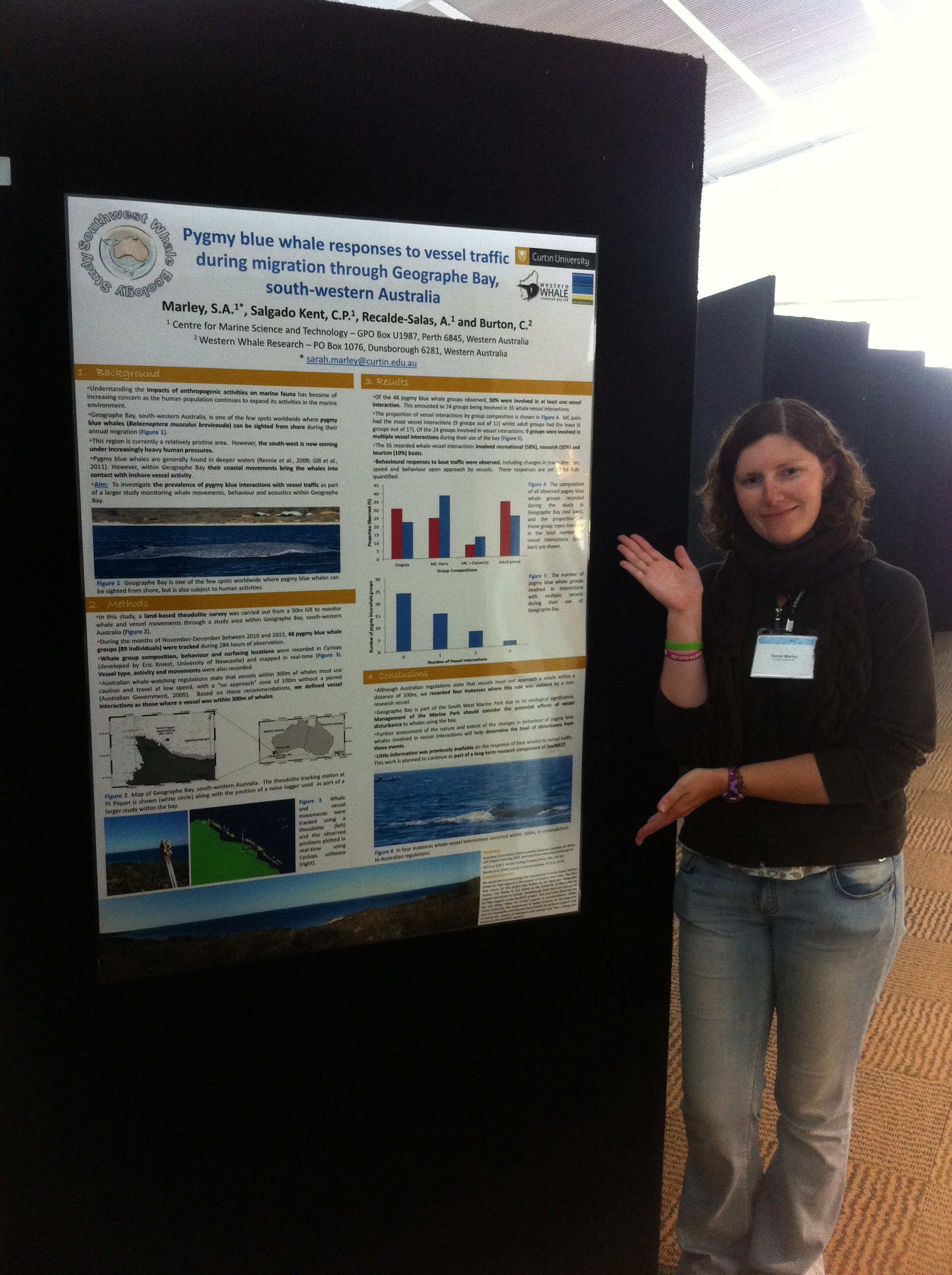
My SMM conference poster describing pygmy blue whale interactions with vessels in Geographe Bay

My SMM conference poster describing pygmy blue whale interactions with vessels in Geographe Bay

I’ve been dying to visit New Zealand for years, so the fact that the Society for Marine Mammalogy (SMM) conference was held in Dunedin this year provided an excellent opportunity / excuse to head over!  You might remember that I had an abstract accepted back in July, meaning that I was able to present some work on the response of pygmy blue whales to vessels in Geographe Bay.  Over 1000 abstracts were accepted for presentation at the conference, and hundreds more people simply attended the proceedings, so this was an excellent chance to not only discuss this research but promote the SouWEST project!

Of course, it also gave us the chance to travel!  Phil and I flew into Auckland on the 29th November and travelled down to Dunedin for the conference by way of hot water beaches, kayak trips, Hobbiton, glow worm caves, kiwis, thermal spas, sperm whales and Hector’s dolphins!  After the conference we headed west to spend a few days exploring the wilderness of Fiordland before heading home, checking out amazing fjords by kayak and boat.

Mid Dec – Now:  Christmas!  (Perth, Western Australia)

Now we’re back in WA and have been immediately thrown into a strange mix of PhD work and Christmas festivities!  After taking the time out to travel, there is a lot of work to catch up on…  But there are also a lot of people to catch up with!  So a 7:30am breakfast meeting the first day home was quickly followed by a CMST Christmas meal with friends (and even a santa!).  Writing emails and funding applications is punctuated by present-swapping and Phil’s amazing Christmas cookies.  Planning of fieldwork is inter-mixed with planning of Christmas morning beach BBQs and dinner with friends.  It’s a strange and busy – but happy – time of the year!

So before I nip off for (another) biscuit I’ll wish you all a merry Christmas and all the best for 2014!

Humpback whales and seismic surveys

This week the “Behavioural response of Australian humpback whales to seismic surveys” (BRAHSS) project kicks off in Western Australia, with the aim of studying how these whales respond to the air guns used in seismic surveys.  This project is one of the largest and most comprehensive studies undertaken on the effects of noise on whales.  And this year I’ll be one of the marine mammal observers working there.

What are seismic surveys?

Seismic surveys use reflections from air gun noise to study the structure of the sea floor (Source:  Open Learn)

Seismic surveys use reflections from air gun noise to study the structure of the sea floor (Source: Open Learn)

Seismic surveys are used by industry to locate oil and gas deposites beneath the sea floor.  These surveys are also used by geoscientists conducting research on submarine rock structures.   This is done using air guns, which produce noise using compressed air.  This noise penetrates the sea floor and ‘bounces back’ off the underlying rock formations.  Survey vessels tow an array of hydrophones (underwater microphones), which receive the reflected noise signals produced by the air guns.  Scientists can examine the readings from this reflected noise to determine the structure of rock strata, and decide whether it is a potential oil / gas site.  Unfortunately, such surveys produce quite a bit of noise and there are concerns regarding the effect of this on marine life.

Where do humpback whales come into this?

Australia is lucky enough to have two populations of humpback whales.  Both populations spend the (austral) summer months feeding in Antarctica; but in the winter, the populations split with one migrating up the West Coast and the other up the East Coast of Australia to their tropical breeding and calving grounds.  During this migration, and particularly on the south-bound journey when females are travelling with young calves, the whales sometimes congregate in coastal bays for a “rest stop”.  This journey takes humpback whales past many sites of human significance, in terms of recreation, transport and industrial work.  Thus it is important to understand how human activities may effect these animals.  Of particular concern are the effects of underwater noise, as marine mammals have specialised hearing which assists with their navigation, foraging and communication.

What will BRAHSS be doing?

Humpback whale making some noise of its own (Photo: S. Marley)

Humpback whale making some noise of its own (Photo: S. Marley)

Broadly, the BRAHSS project aims to provide information that will reduce uncertainty in evaluating the impacts of seismic surveys on humpback whales.  This will lead to improved management and mitigation measures, allowing such surveys to be conducted efficiently and with minimum impact on the whales.  The project has previously run two successful research seasons off the East Coast of Australia in 2010 and 2011.  It is now repeating these experiments on the West Coast population of humpback whales.

As a marine mammal observer (MMO) on the project, I will be off to Dongara in Western Australia for the next 6wks.  My role will be to assist in spotting humpback whales and tracking their movements from the survey vessel, in addition to monitoring animal behaviours in response to air gun noise.  Dongara is reputed to be a pretty bouncy area sea-wise, so hopefully I manage to keep sea-sickness at bay (and don’t have to put my sea survival skills to the test!) – but it’ll be good to get out with some whales again 🙂

Event: Come say hello at Fremantle Maritime Day!

Maritime DayThis Saturday, Fremantle Port is hosting the Maritime Day Expo down at Victoria Quay in Fremantle.  And yours truly will be there helping out at the Coastal and Estuarine Dolphin Project (CEDP) stall!  So come down, have a chat, and check out our Fin-Matching and What’s that Sound? games, research progress, and general dolphin info!

There will also be free harbour boat rides, a Svitzer tug on show, the guided missile frigate HMAS Sydney open for visiting, a Navy vs Port cook-off, kids activities, live bands and other entertainment on offer.  The CEDP stall will be down in B Shed, along with over 40 other maritime displays and career stalls.  For the full program of what’s on, click here.

The event itself is open to the public from 10am – 4pm, and my stall shift is from 12-2pm.  So come say hello 🙂

Our supercool "Listening to Dolphins" poster for the Maritime Day Expo in Fremantle

Our supercool “Listening to Dolphins” poster for the Maritime Day Expo in Fremantle

Survival of the Fittest – evacuations, liferafts, and getting stabbed by a “first aider”

Next month I’ll be heading off for a few weeks to assist on a research project investigating the behavioural response of humpback whales to seismic surveys.  Although we’ll be returning to shore each night, there will be a fair bit of time bouncing around on the continental shelf off Western Australia.  So, to get all my health and safety up to date, this week I’ve been attending courses in sea survival and first aid.

Sink or Swim…

On Wednesday, Angela and I were off to ERGT Australia to attend their Apply Offshore Facility Abandonment and Sea Survival Procedures (FAB) course.  This involved quite a bit of apprehension.  We had heard various horror stories from BOSIET veterans about jumping from heights into a pool and, after an unfortunate adventure a few years ago that involved me taking the shortest route down a cliff face, I wasn’t particularly keen on jumping from anywhere.  Plus the idea of floundering around in the water making pratts of ourselves infront of a bunch of tough male riggers wasn’t exactly appealing!

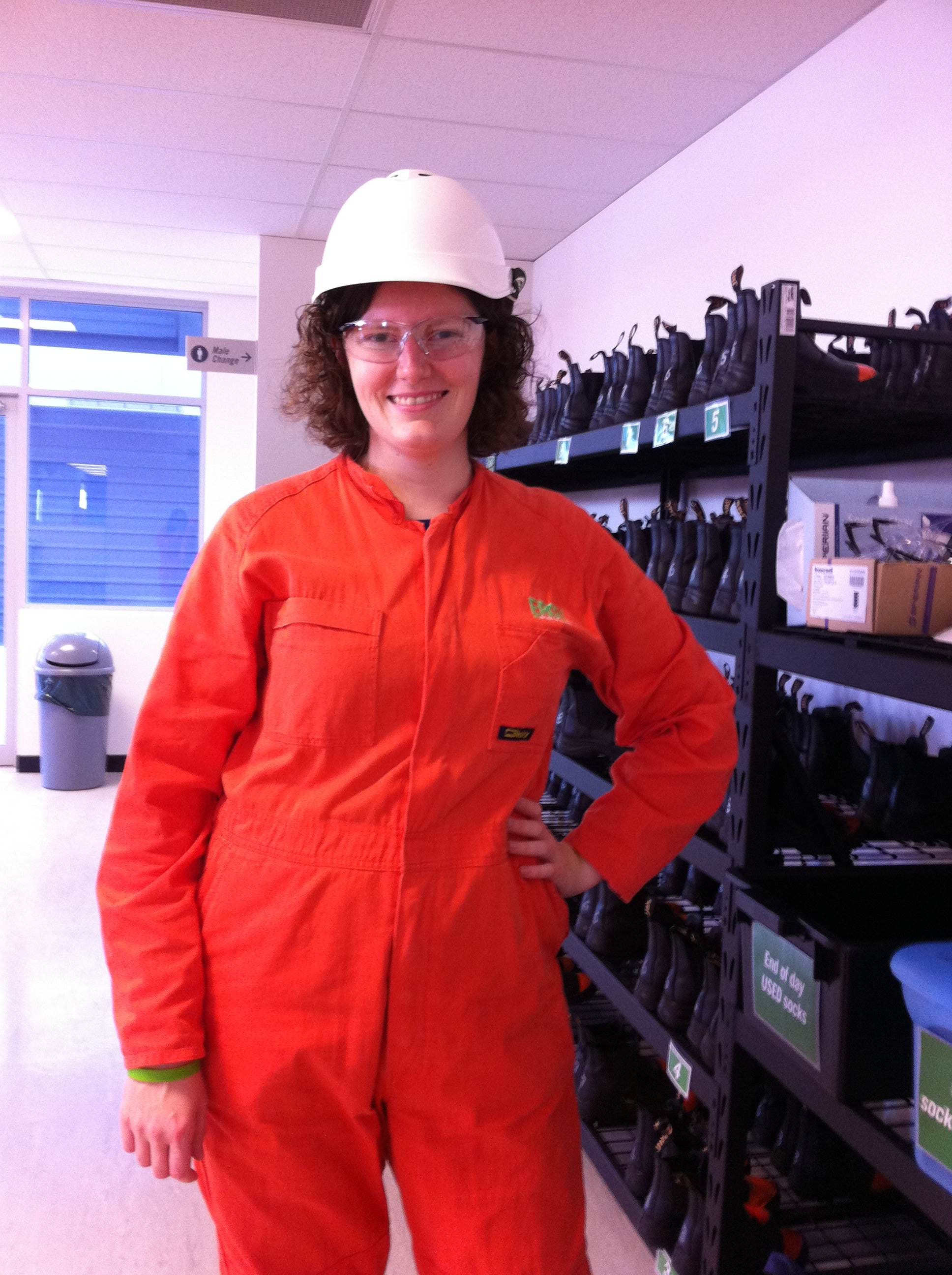
Never has sea survival looked so good ;)

Never has sea survival looked so good 😉

We arrived and got kitted out in our ‘work gear’, as ERGT want you to be ‘in the zone’ during your training (bonus points:  we totally rocked the orange boiler suits).  The morning was full of theory about how to evacuate an offshore facility and different strategies for survival following abandonment.  We learned about different methods for getting off the facility, from the preferred (walking off and onto a jetty) to the emergency exits (lifeboat or liferaft) to the last chance (jumping off). Johanne, the Instructor / Eye-Candy, explained different types of lifeboat and liferaft (note:  the former is an actual vessel which you’ll probably do alright in, the latter is essentially an inflatable tent) and how to deploy them.  He also explained how to put on a lifejacket, the best way to enter the water (watch the horizon, use your hand to block off your nose and mouth, straight legs), and how to adopt the HELP position to minimise rate of hypothermia once in the sea.

Easy peasy, we were thinking.  Now time to put it into practice in the pool, says Johanne.!  Uh oh…

But it was actually really good fun!  First we had a mock evacuation drill – the sirens went and we had to grab our lifejacket and hardhat, reach the muster point and enter the lifeboat.  This was then actually descended from three storeys into a small pool, which was quite a weird experience.  After that, we went to worst case scenario.  We went up to the first platform (thankfully only 1m above the pool rather than the next one at 4.5m!) and Johanne explained again how to jump in.  At this stage, all the big burly riggers who had been standing next to the edge suddenly disappeared to the back of the group, leaving me to go first!  Nice to know chivalry isn’t dead…  We tried the HELP position, practiced coordinating as a group, and did drills of saving each other from burning oil platforms (even if some of us dragged our victims towards the platform instead *cough Angela cough*).  Then we had to try getting into a deployed liferaft from the water.  Despite Johanne’s instruction of ‘one at a time’, all the riggers dashed off towards the raft together.  What happened to ladies first?!  Once we were all in the raft, we got airlifted to safety – a loop was descended from the higher platform, which we put under our arms and we got lifted up – much to the amusement of the riggers, as we dangled mid-air!

Would you know what to do?

On Thursday and Friday we attended an Apply First Aid course with St John Ambulance Australia.  This course covers a wide range of topics, including CPR, the Recovery Position, Defibrillation, Choking, Severe Bleeding, Allergic Reactions, Shock, Burns, Animal Bites, Fractures, Heat-Induced Conditions, and lots more.  Very comprehensive!  The instructors, Mike and Brooke, were fantastic with a wealth of knowledge and experience to share with the class.  Angela and I had great fun bandaging each other up and practising different first aid scenarios, even if she did get a bit over-enthusiastic…  When I was pretending to have an allergic reaction she grabbed the fake epi-pen and, with a cry of “I’ll save you Saz!”, stabbed it into my leg with enough force to leave me numb all morning!

But one of the things that surprised me on this course was the number of people doing it for the first time.  I am pretty accident-prone (see falling off cliffs above!), and have been very lucky in that I have usually had someone with some kind of first aid knowledge nearby to sort me out.  Even when this wasn’t the case, I’ve been able to self-administer first aid thanks to completing several courses before.

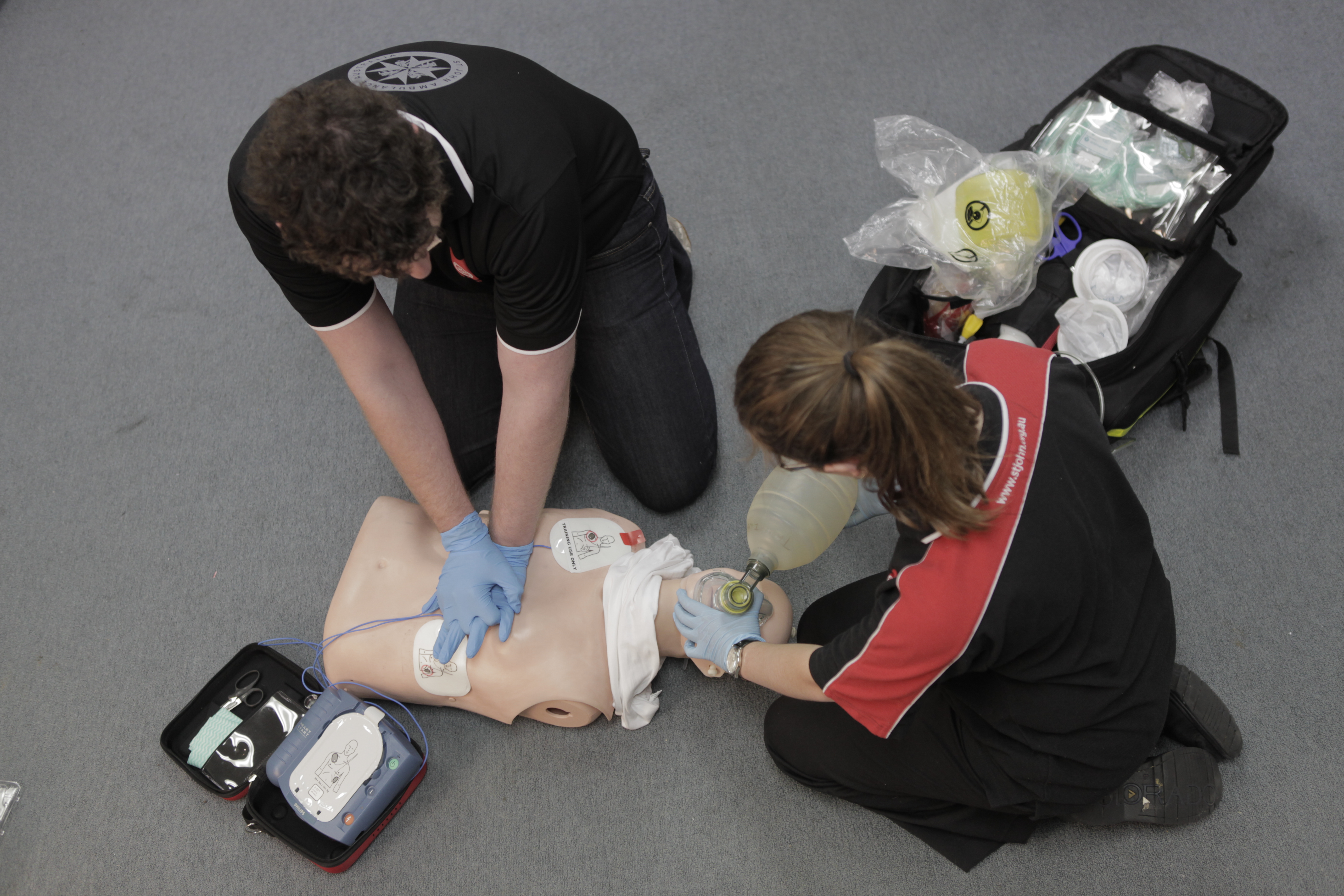
A defibrillator tries to 'reset' the heart's normal rhythm.  They are available in a range of public places in case of emergency - but could you use one?

A defibrillator tries to ‘reset’ the heart’s normal rhythm. They are available in a range of public places in case of emergency – but could you use one? (Image:  St Johns Ambulance Australia)

When asked why they have never done a course like this before, most people in the class said they were scared of being in an emergency situation and doing the wrong thing.  But, as the instructors pointed out, I would feel far worse seeing someone in desperate need and being unable to do anything to help them.  If someone is hurt or unconcious, they are already in a bad situation – it is highly unlikely that you could do anything to make things worse.  But by trying to help and offering first aid, you are giving them a chance.  The leading cause of death in Australia involves heart-related conditions, mostly heart attacks when breathing stops and the heart ceases to pump blood.  On average, it will take 20mins for an ambulance to arrive – but within 3-5mins, your brain will start to die from lack of oxygen.  If you can perform CPR for just quarter an hour, you significantly improve the victims chances of survival.

If you have never done this, or if it has been a while since the last one, please go do a first aid courseSt Johns Ambulance offer a wide range of courses at varying prices.  If you are a student, check what’s available through the university – I know that Curtin University and the University of Western Australia here in Perth both offer discounted courses to students.  It looks good on your CV, it’s fun to do, and if you can think of at least one person you wouldn’t want to lose, then you owe it to them to know what to do in an emergency.  Hopefully you’ll never have to do so, but if you did – what would you do?

Did you hear? Recording whale sounds in Albany

This weekend the Centre for Marine Science and Technology (CMST) deployed two noise loggers in Albany, Western Australia to record underwater sounds, and I had the pleasure of assisting!

Ready…

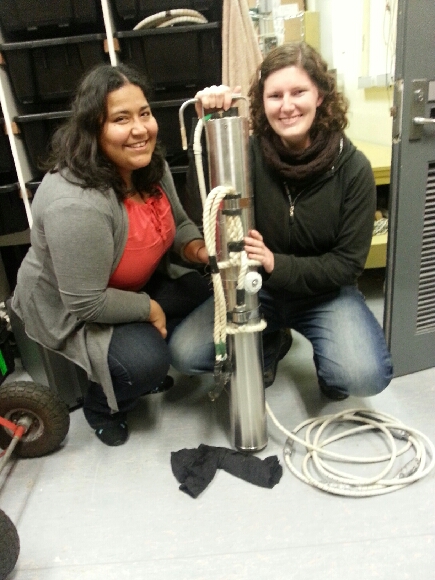
Angela and I with our first ever sea noise logger!

Angela and I with our first ever sea noise logger!

On Thursday, my supervisor Dr Chandra Salgado Kent (deputy director of CMST) showed Angela and I how to calibrate and prepare the noise loggers, which are specially designed and built by CMST.  Essentially an underwater microphone, the noise loggers have previously been deployed all around the Australian coast, allowing CMST to build up a catalogue of underwater sounds and tackle various questions in marine acoustics research.  As the centre’s two newest PhD students, these are pieces of equipment we are going to become very familiar with over the next few years!  We were shown how to program the noise loggers, which can be set to different sampling rates – they might record most of the time, or only every so often depending on the research question.  We also learnt how to secure the noise loggers in their casing, ready for deployment!

… Set …

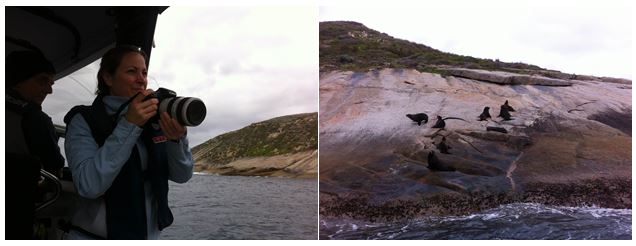
The next day Chandra, Jose and I drove the two noise loggers down to Albany, ready for an early-morning deployment on Saturday.  Two officers from the newly formed Department of Parks and Wildlife (DPaW) kindly met us at 7am to help finish preparing the noise loggers, then took us out in their vessel to deploy the loggers along with a representative from Albany Port.  Although there was a wee bit (i.e. fricking huge amount) of swell, we managed to get both loggers deployed in King George Sound – success!  We were also lucky enough to spot some marine mammals, with both bottlenose and common dolphins popping up next to the boat and plenty of New Zealand fur seals lounging around on the rocks.  A promising sign for a marine mammal research project!

Chandra gets some photos of the New Zealand fur seals off Albany

Chandra gets some photos of the New Zealand fur seals off Albany

… Go!

Now the noise loggers will (hopefully!) record for the next two months, recording the underwater ‘soundscape’ of King George Sound.  The project is a first for Albany, and will record all sounds produced in the bay be it from natural (waves, rain), biological (fish, whales, dolphins), or man-made (ships) sources.  But the main focus of this project are the humpback and southern right whales which use the area during their seasonal migrations.

Whales appear to be very vocal, with male humpbacks being particularly renowned for their ‘songs’, the purpose of which is still under debate.  However, both male and female whales also appear to produce ‘social sounds’, which may be used in various behavioural contexts.  The type and number of calls recorded help to give an idea of how many whales might be present in the area, and what they are up to.  This data will act as a pilot field season, which can be built upon in future years to establish trends in whale abundance and seasonality over time.  This will provide an idea of migration patterns for these species.  It’s an exciting development, and has already received media attention from the local press (“Whale song to be recorded“).

Now we just have to wait two months to hear what the whales are saying!

Mapping Unexpected Visitors – sightings of uncommon marine species

The coastal town of Albany, Western Australia had a surprise visitor this week, in the rather large form of a southern elephant seal.  Although still just a juvenile, this 2.5m male is thought to weigh-in at somewhere between 500 and 700 kg – not exactly something you want to find in your front yard!  But when Rhonda Bell looked outside, that’s exactly what she found!

The seal has been basking on Rhonda’s beachside property on-and-off over the last week, occasionally moving up and down the coastal road.  Local residents have been turning up by the dozen to check out the unusual marine mammal.  Southern Elephant Seals breed in colonies on South Georgia, Macquarie Island, Heard Island and the Kerguelen Islands. For most of the year they live in the cold oceans of the sub-Antarctic.  However, at this time of year winter fronts can sweep in various migratory animals to Western Australia.  Since elephant seals are used to travelling long-distances (records of an elephant seal travelling 18,000 miles over a year), no doubt this one will none the worse for wear.

In the meantime, the media are having a field day with seal-related puns as a result (my personal favourite “Sealed road a big hit with locals“).  Although worryingly, not many people seem to know much about the animal.  One local kid was quoted as saying “I wasn’t sure what it was – I thought maybe a remote-controlled hippopotamus” (see the video here).  Oh dear…

The 'sea monk' was a monster from the North Sea - not sure if there's a Redmap category for this!

The ‘sea monk’ was a monster from the North Sea – not sure if there’s a Redmap category for this!

But admittedly, when something strange appears in your local patch of ocean, how are you supposed to figure out what it is?

One new initiative is trying to map the occurrence of ‘uncommon’ marine species sightings using citizen science.  Started by the Institute for Marine and Antarctic Studies (IMAS), the Redmap project invites Australians to share sightings of marine species that are unusual in their local seas.  Over time, Redmap will use this information to map changes in species distribution and ranges and try to determine the cause (e.g. changes in the marine environment).  The added benefit to you, is that once a sighting is logged it goes to a scientist for verification.  This means that you can get an expert opinion to confirm whatever strange species you come across.

Another good reason to go check out the ocean!  You never know what you might find, and it might just help scientific research!

Pursuing a Higher Degree: Why I’m so happy to be starting a PhD!

Last week I officially enrolled as a PhD student at Curtin University!  Here I will spend the next three years studying the response of dolphins to underwater noise.

For the last two years, I have been applying for PhD scholarships.  At the same time, to try and continue boosting my CV, I volunteered on various marine mammal projects.  This meant a lot of late nights, working weekends, unpaid leave from work, neglecting my boyfriend and basically quite a bit of juggling.  There were times when I felt overwhelmed and wondered if all this effort was ever going to lead anywhere.  But there were also a lot of fun times, filled with interesting discoveries, new friends, and happiness at pursuing something I loved.

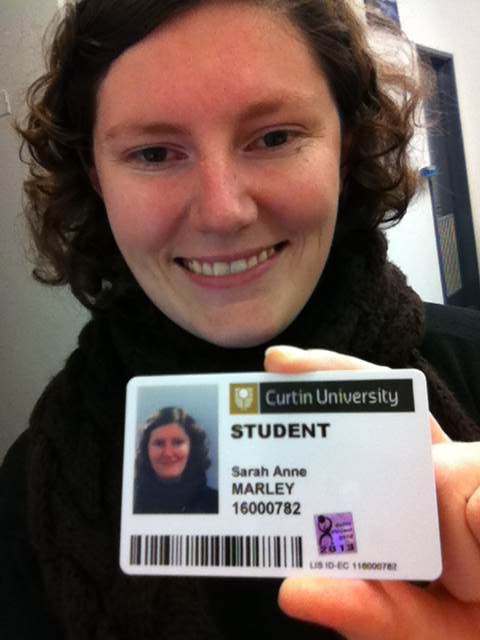
Hope the buzz lasts three years!

Hope the buzz lasts three years!

The day I signed the last piece of paperwork I spent the next 24hrs bouncing around, occassionally squeeling to myself with pure happiness (yes, really!).  Now, a week later, the excitement has become a bit more manageable but I still get a buzz every time I look at my student card.  I’ve chosen a desk in the Higher Degree by Research student building.  I’m changing my email signature.  I’m keeping a colour-coded PhD notebook full of lists, thoughts and notes (much to the amusement of my more cynical colleagues, who frequently ask how long that is going to last).

So why is this such a big deal to me?  What’s so great about a PhD?  Here are the top three reasons why I decided to pursue a PhD:

1.  Curiosity

When I worked in science communication, we used to introduce science to kids by saying “Have you ever asked a question?  Wanted to know why, what or how?  Then you’re a scientist!”.  A bit basic, but fundamentally true – much of science is driven by pure curiosity and the desire to learn.  A PhD is an excellent opportunity to explore several avenues of curiosity about a specific topic, at a depth and intensity that will eventually satisfy almost everyone (probably overly so).

2.  A Love of Research

My childhood dolphin-spotting point in Banff, Scotland (click here for live webcam!)

My childhood dolphin-spotting point in Banff, Scotland (click here for live webcam!)

As a kid I used to spend my school holidays watching the dolphins in Banff Harbour (Scotland), recording sighting times, group compositions and animal behaviour.  Although I didn’t realise it, this was the start of my research career.  Since leaving full-time education, I’ve tried a range of jobs:  sales assistant, bosun on a tourism boat, tutoring, supermarket check-outs, university lecturer, setting myself on fire in the name of science communication…  But any length of time away from research is painful.  I miss learning new things, the craziness of fieldwork, the excitement of getting results.  Research just fits me.

3.  The Challenge

The other thing I miss is being challenged.  Although it’s more than likely that I’m going to regret this statement at some point over the next three years.  But the truth is, it’s only by pushing ourselves and going beyond the comfort zone that we develop.  That’s certainly what I expect a PhD to do!

But of course, this is just my opinion.  Did you have other motivations for pursuing a PhD?  Or perhaps decide against it?  Let me know!  I know that this is the honeymoon period and the real work is yet to come, but for now I’m just enjoying the moment.  At least when I hit the (inevitable) hard patches, I’ll have this list to check back on!  After all, nothing worth having ever comes easy.