Category Archives: Whales and Dolphins

Did you hear? Recording whale sounds in Albany

This weekend the Centre for Marine Science and Technology (CMST) deployed two noise loggers in Albany, Western Australia to record underwater sounds, and I had the pleasure of assisting!

Ready…
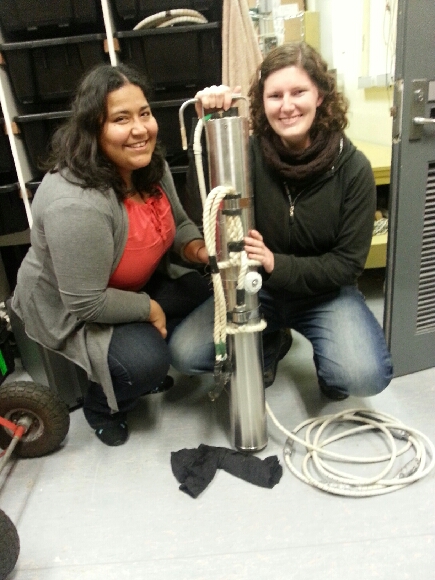
Angela and I with our first ever sea noise logger!

Angela and I with our first ever sea noise logger!

On Thursday, my supervisor Dr Chandra Salgado Kent (deputy director of CMST) showed Angela and I how to calibrate and prepare the noise loggers, which are specially designed and built by CMST.  Essentially an underwater microphone, the noise loggers have previously been deployed all around the Australian coast, allowing CMST to build up a catalogue of underwater sounds and tackle various questions in marine acoustics research.  As the centre’s two newest PhD students, these are pieces of equipment we are going to become very familiar with over the next few years!  We were shown how to program the noise loggers, which can be set to different sampling rates – they might record most of the time, or only every so often depending on the research question.  We also learnt how to secure the noise loggers in their casing, ready for deployment!

… Set …

The next day Chandra, Jose and I drove the two noise loggers down to Albany, ready for an early-morning deployment on Saturday.  Two officers from the newly formed Department of Parks and Wildlife (DPaW) kindly met us at 7am to help finish preparing the noise loggers, then took us out in their vessel to deploy the loggers along with a representative from Albany Port.  Although there was a wee bit (i.e. fricking huge amount) of swell, we managed to get both loggers deployed in King George Sound – success!  We were also lucky enough to spot some marine mammals, with both bottlenose and common dolphins popping up next to the boat and plenty of New Zealand fur seals lounging around on the rocks.  A promising sign for a marine mammal research project!
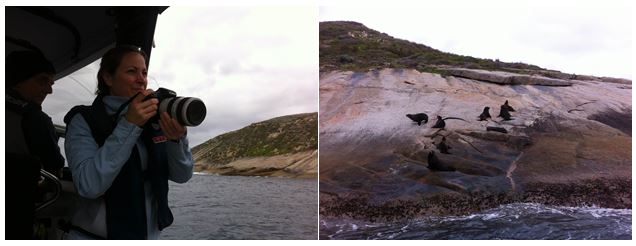
Chandra gets some photos of the New Zealand fur seals off Albany

Chandra gets some photos of the New Zealand fur seals off Albany

… Go!

Now the noise loggers will (hopefully!) record for the next two months, recording the underwater ‘soundscape’ of King George Sound.  The project is a first for Albany, and will record all sounds produced in the bay be it from natural (waves, rain), biological (fish, whales, dolphins), or man-made (ships) sources.  But the main focus of this project are the humpback and southern right whales which use the area during their seasonal migrations.

Whales appear to be very vocal, with male humpbacks being particularly renowned for their ‘songs’, the purpose of which is still under debate.  However, both male and female whales also appear to produce ‘social sounds’, which may be used in various behavioural contexts.  The type and number of calls recorded help to give an idea of how many whales might be present in the area, and what they are up to.  This data will act as a pilot field season, which can be built upon in future years to establish trends in whale abundance and seasonality over time.  This will provide an idea of migration patterns for these species.  It’s an exciting development, and has already received media attention from the local press (“Whale song to be recorded“).

Now we just have to wait two months to hear what the whales are saying!
Dolphin Watch: Community Science in Action

How can a small team of scientists hope to measure a community of bottlenose dolphins – highly mobile animals – inhabiting a river stretching 60km through the capital of Western Australia?  By creating a network of citizen scientists!

The Swan-Canning Riverpark is an estuarine protected area flowing through Perth, WA.  Despite being situated in a major metropolitan area (over 1.4 million people), the river is home to a resident community of approximately 20 Indo-Pacific bottlenose dolphins.  Murdoch and Curtin Universities are leading the research into Perth’s Swan River dolphins, investigating how environmental changes in the river and human activities can affect the dolphin community.  For more information on the latest paper from this project, please click here.

Dolphin Watching for Science

Click here to view the Dolphin Watch Annual Report 2012-13

Click here to view the Dolphin Watch Annual Report 2012-13

The Dolphin Watch project is a partnership between the Swan River Trust’s River Guardians program, and Murdoch and Curtin Universities.  It was instigated in April 2009 to learn more about the bottlenose dolphins residing in the Swan and Canning Rivers by training members of the local community to monitor the dolphins.

On Friday evening I had the pleasure of attending Dolphin Watch Day 2013.  Each year, the amazing  contribution of the Dolphin Watch volunteers are celebrated on Dolphin Watch Day, providing an opportunity to share the most recent discoveries and research news.  Since the project began in 2009, volunteers have contributed 7,180 records of dolphin sightings detailing the location, group size and behaviour of animals seen in the river.  This has helped develop scientists’ understanding of how the dolphins are using this area, and will support the conservation of these much-loved locals.

Benefits for scientists…

Marine mammals are difficult to spot at the best of times.  But trying to track them down in a long river system, full of bays and inlets, can be a time-consuming process.  However, each year thousands of people use the Swan River for sport, recreation and travel.  If those people are already out on the river, it makes sense to make use of local knowledge to discover more about the ecosystem and its inhabitants.  Dolphin Watch essentially gives the scientists ‘eyes’ along the whole length of the river.

The growing size of this data set will allow scientists to begin studying long-term trends in dolphin habitat use and behaviour.  It will also improve their ability to detect changes in population size and behaviour which may effect the conservation of these iconic animals.  Citizen science projects such as this help us to develop our understanding of the world around us, and directly contribute to important research and conservation efforts.

… as well as volunteers!

This ever increasing amount of date is due to the growing size of Dolphin Watch, as well as the ongoing efforts of established members.  With almost 600 members of the Perth community out voluntarily monitoring the river, it is extremely heartening to see so many people taking an interest in preserving the local environment and it’s fauna.

But it’s more than just spotting the occasional dolphin.  People go out of their way to attend training sessions, fill in sighting reports, and spend hours scanning the water.  Already this year, they have submitted over 600 sightings so far – that’s a total of 2,467 hours dolphin watching!  A phenomenal effort!

And this is because people care.  They take an interest in the world around them, and want to know the outcomes of the research they’re helping to conduct.  They enjoy spending time in the natural environment, and want to ensure that future generations have the same opportunity.  They are an inspiration – and I hope their numbers continue to swell, bringing benefits to not only the dolphin community but our own community as well.

More Info?

The Dolphin Watch Annual Report (2012-13) became available on 14th June 2013.  For more information about the work of this exemplary citizen science program, have a flick through the report here!