Tag Archives: Science

Mapping Unexpected Visitors – sightings of uncommon marine species

The coastal town of Albany, Western Australia had a surprise visitor this week, in the rather large form of a southern elephant seal.  Although still just a juvenile, this 2.5m male is thought to weigh-in at somewhere between 500 and 700 kg – not exactly something you want to find in your front yard!  But when Rhonda Bell looked outside, that’s exactly what she found!

The seal has been basking on Rhonda’s beachside property on-and-off over the last week, occasionally moving up and down the coastal road.  Local residents have been turning up by the dozen to check out the unusual marine mammal.  Southern Elephant Seals breed in colonies on South Georgia, Macquarie Island, Heard Island and the Kerguelen Islands. For most of the year they live in the cold oceans of the sub-Antarctic.  However, at this time of year winter fronts can sweep in various migratory animals to Western Australia.  Since elephant seals are used to travelling long-distances (records of an elephant seal travelling 18,000 miles over a year), no doubt this one will none the worse for wear.

In the meantime, the media are having a field day with seal-related puns as a result (my personal favourite “Sealed road a big hit with locals“).  Although worryingly, not many people seem to know much about the animal.  One local kid was quoted as saying “I wasn’t sure what it was – I thought maybe a remote-controlled hippopotamus” (see the video here).  Oh dear…

The 'sea monk' was a monster from the North Sea - not sure if there's a Redmap category for this!

The ‘sea monk’ was a monster from the North Sea – not sure if there’s a Redmap category for this!

But admittedly, when something strange appears in your local patch of ocean, how are you supposed to figure out what it is?

One new initiative is trying to map the occurrence of ‘uncommon’ marine species sightings using citizen science.  Started by the Institute for Marine and Antarctic Studies (IMAS), the Redmap project invites Australians to share sightings of marine species that are unusual in their local seas.  Over time, Redmap will use this information to map changes in species distribution and ranges and try to determine the cause (e.g. changes in the marine environment).  The added benefit to you, is that once a sighting is logged it goes to a scientist for verification.  This means that you can get an expert opinion to confirm whatever strange species you come across.

Another good reason to go check out the ocean!  You never know what you might find, and it might just help scientific research!
Pursuing a Higher Degree: Why I’m so happy to be starting a PhD!

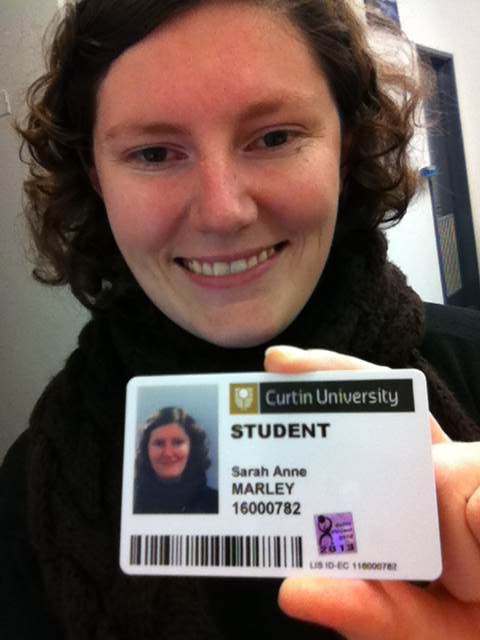
Last week I officially enrolled as a PhD student at Curtin University!  Here I will spend the next three years studying the response of dolphins to underwater noise.

For the last two years, I have been applying for PhD scholarships.  At the same time, to try and continue boosting my CV, I volunteered on various marine mammal projects.  This meant a lot of late nights, working weekends, unpaid leave from work, neglecting my boyfriend and basically quite a bit of juggling.  There were times when I felt overwhelmed and wondered if all this effort was ever going to lead anywhere.  But there were also a lot of fun times, filled with interesting discoveries, new friends, and happiness at pursuing something I loved.

Hope the buzz lasts three years!

Hope the buzz lasts three years!

The day I signed the last piece of paperwork I spent the next 24hrs bouncing around, occassionally squeeling to myself with pure happiness (yes, really!).  Now, a week later, the excitement has become a bit more manageable but I still get a buzz every time I look at my student card.  I’ve chosen a desk in the Higher Degree by Research student building.  I’m changing my email signature.  I’m keeping a colour-coded PhD notebook full of lists, thoughts and notes (much to the amusement of my more cynical colleagues, who frequently ask how long that is going to last).

So why is this such a big deal to me?  What’s so great about a PhD?  Here are the top three reasons why I decided to pursue a PhD:

1.  Curiosity

When I worked in science communication, we used to introduce science to kids by saying “Have you ever asked a question?  Wanted to know why, what or how?  Then you’re a scientist!”.  A bit basic, but fundamentally true – much of science is driven by pure curiosity and the desire to learn.  A PhD is an excellent opportunity to explore several avenues of curiosity about a specific topic, at a depth and intensity that will eventually satisfy almost everyone (probably overly so).

2.  A Love of Research

My childhood dolphin-spotting point in Banff, Scotland (click here for live webcam!)

My childhood dolphin-spotting point in Banff, Scotland (click here for live webcam!)

As a kid I used to spend my school holidays watching the dolphins in Banff Harbour (Scotland), recording sighting times, group compositions and animal behaviour.  Although I didn’t realise it, this was the start of my research career.  Since leaving full-time education, I’ve tried a range of jobs:  sales assistant, bosun on a tourism boat, tutoring, supermarket check-outs, university lecturer, setting myself on fire in the name of science communication…  But any length of time away from research is painful.  I miss learning new things, the craziness of fieldwork, the excitement of getting results.  Research just fits me.

3.  The Challenge

The other thing I miss is being challenged.  Although it’s more than likely that I’m going to regret this statement at some point over the next three years.  But the truth is, it’s only by pushing ourselves and going beyond the comfort zone that we develop.  That’s certainly what I expect a PhD to do!

But of course, this is just my opinion.  Did you have other motivations for pursuing a PhD?  Or perhaps decide against it?  Let me know!  I know that this is the honeymoon period and the real work is yet to come, but for now I’m just enjoying the moment.  At least when I hit the (inevitable) hard patches, I’ll have this list to check back on!  After all, nothing worth having ever comes easy.

The Importance of Attending Conferences

In December 2013, the Society for Marine Mammalogy will be holding its biennial conference on the biology of marine mammals in Dunedin, New Zealand.  Last Friday, I was notified that I am lucky enough to be presenting at the conference!  But why are conferences such a big deal?

What is the SMM conference?

The Society for Marine Mammalogy (SMM) biennial conference is a gathering of marine mammal scientists from around the world, with the goal of enhancing collaboration, sharing ideas, and improving the quality of research on marine mammals.  Every SMM conference has a fantastic turnout, with hundreds of scientists in attendance.  This year promises to be no different, with over 1000 abstracts for talks and posters being submitted.  Unfortunately, about 20% of these were rejected.  But 200 talks and 400 posters have been accepted for the event.

What will I be presenting?

Pygmy blue whale and vessel; Geographe Bay, Western Australia

Pygmy blue whale and vessel (Geographe Bay, Western Australia) – how close is too close?

I will be presenting a poster based on work by myself and colleagues at the Southwest Whale Ecology Study (SouWEST).  Check out my Projects page for more information on this group.  The poster will document the responses of pygmy blue whales to vessel traffic during their migration through Geographe Bay, Western Australia.  Understanding the impacts of anthropogenic activities on marine fauna has become of increasing concern as the human population continues to expand its activities in the marine environment.  The SMM conference will be an excellent opportunity to share our research findings with the scientific community.

What’s the point of conferences?

Of course, conferences aren’t just a way of spreading the word about your own work – they’re also a great chance to hear about developments in your field and keep up-to-date with recent research.  The best part is that if you have questions or would like to know more about any particular topic, the researchers are right there to ask!  Conferences are great networking opportunities, whether you’re a student looking for a job, a professor looking for students, or a researcher interested in finding collaborators for a particular project.  Since presentations are often discussing work at varying stages (from preliminary findings through to recently published), it is also a good chance to get some informal peer-feedback.  Plus, you often get to travel to pretty cool places!

But for me the best thing about academic conferences is this:  inspiration.  Being surrounded by passionate people, new ideas, recent discoveries…  It all acts as a massive source of motivation and encouragement to continue in what can sometimes be a difficult field.  Everyone needs a pick-me-up sometimes, and I find the buzz of conferences invigorating.

So bring on New Zealand!

The Virtual Scientist

In a survey from 2011, only 4% of Americans could name a living scientist.

Can you identify these scientists?

Can you identify these scientists?

Many people may be unable to name a living scientist.  But they certainly know where to go to find out more:  the internet.

With the words “just Google it” becoming an everyday phrase, the internet is now a place to find answers to all life’s little questions.  What was the footie score?  Where shall we go for dinner?  Which car should I buy?  It is a platform being rapidly utilised by retailers and advertising companies.  But it is also fulfilling an educational capacity, with material ranging from pre-school to post-doctoral level now widely available.

Interphobia

(yes it’s a real term – just Google it!)

Over the past couple of months, I have attended several talks encouraging scientists to fully utilise the online world.  The idea of creating an ‘online presence’ is a hot topic just now, yet many scientists and researchers are reluctant to participate.

The internet can be a scary place.  It is full of viruses, hackers, trolls and a whole range of people out to steal your money / identity / intellectual property.  It can also be ruthlessly subjected to ‘word of mouth’, with information being rapidly passed from one person to the next.  With the possibility of becoming the misquoted scientist, this can be terrifying for many researchers.

But the internet also offers substantial rewards.

Although environmental science is now being widely discussed in schools, most people over the age of 35 were never formally taught about climate change.  Rather, they have had to obtain their information from publically-accessible sources, such as newspapers, magazines, and social media.  The latter in particular is a rapidly increasing information source.  In fact, it offers the perfect opportunity to turn ‘word of mouth’ from a curse to a blessing!

How many of you check Facebook in the morning?  Have a quick look at Twitter on your break?  Perhaps you’re even one of the many who check social media before you even get out of bed?  If so many people are using social media, then why not scientists?!  The internet offers a much wider audience than previously available through academic publications, press releases or public seminars alone.

Why scientists should get online

Jo Hawkins, a digital marketing specialist, has written an excellent article giving 8 reasons why academics should invest in their online reputation.  In a nutshell, the use of online platforms are an excellent two-way street linking scientists and non-scientists.  Researchers have the opportunity to engage with the general public, contribute to education, and spread word of their research to a wide audience.  But in return, the general public get the chance to see ‘the person behind the labcoat’, easily find an accessible authority to question on topics of interest, and learn about lots of interesting projects happening around the world.  Win-win!

Science is all around us.  This week, try adding an extra dollop of it to your daily life and find at least one scientist to follow online.  Who knows what you may discover!