And the winner of the 3-Minute-Thesis competition is…

3MT Trans-Tasman Competition 2014 Sarah Marley and Rosanna Stevens

3MT Trans-Tasman 2014 Sarah Marley and Rosanna Stevens

…  Sarah Marley from Curtin University

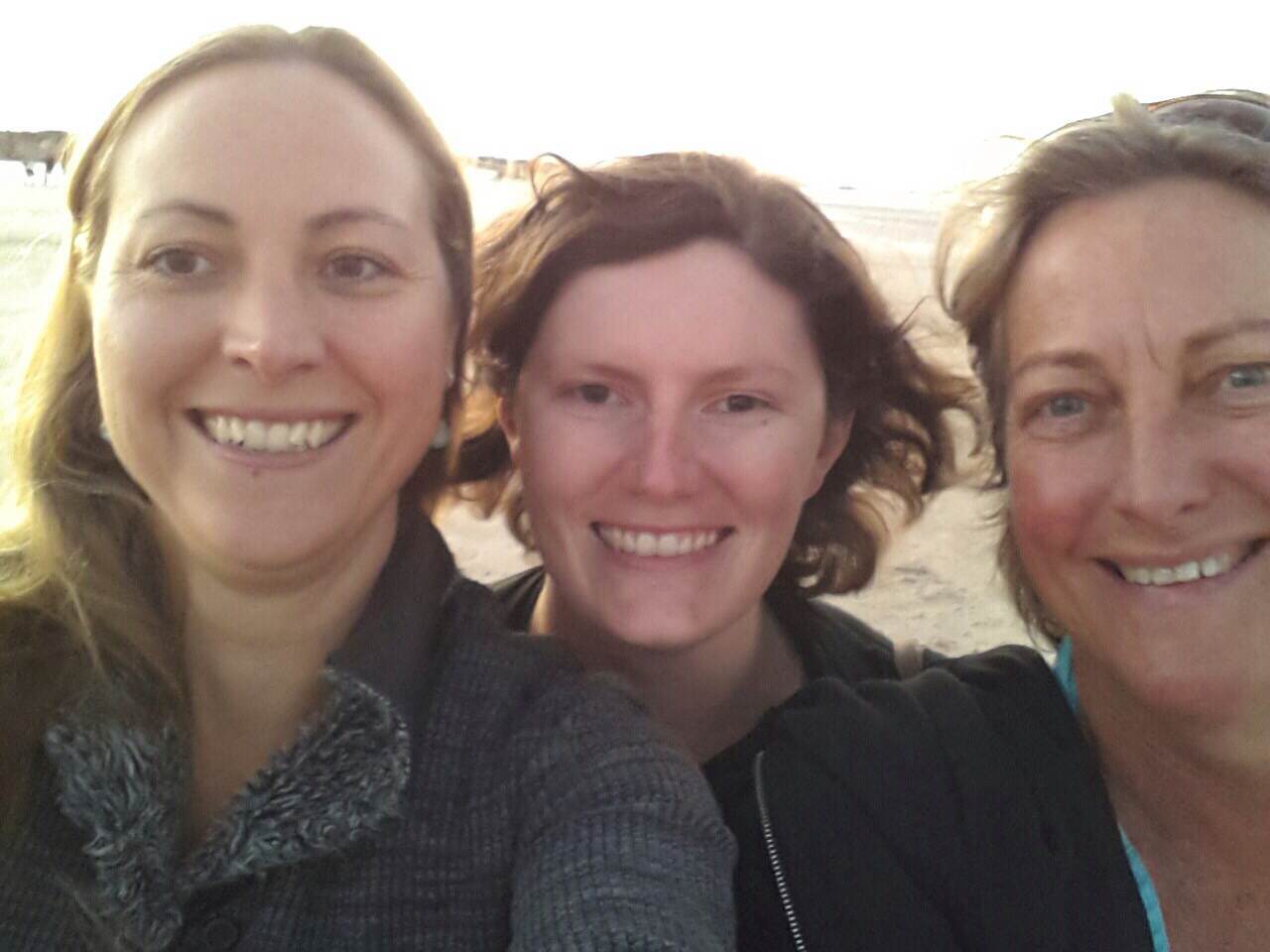
When I heard those words, my heart stopped.  I did the “shocked-actress-wins-award” face.  I hugged my friends sitting on either side.  I repeatedly gasped “oh my goodness“.  I may have even made a rather embarrassing Oscar-worthy acceptance speech.  Now over a week later and I am still riding the high 🙂

View the talk below:

Now let’s back up a bit.

The 3-Minute-Thesis (3MT) competition was developed by the University of Queensland back in 2008.  It was intended to be an exercise in communication for graduate students, giving them just three minutes to explain their PhD to a generalist audience.  Since then, the competition has expanded to universities around the world.

I’ve known about this competition for a couple of years now, after seeing various friends compete to present their own PhD at other universities.  I couldn’t wait to become a student myself and give it a go!  So when Curtin University emailed around to announce that registration was open for the 2014 competition I immediately sat down, wrote my talk in 20mins, and started practicing!

The Curtin heats were a couple of months ago, where I surprised myself by not only making it through to the Curtin Final top ten but also by winning my heat.  “A great start,” I thought.  “Now back to fieldwork!” as I prepared for the second trip up to the Kimberleys.  A few weeks later, I made the special one-night-only trip back from Broome to Perth for the Curtin Final, and won both the Final and the People’s Choice award!  Certainly justified the trip down!

All the competitors from the 3MT Trans-Tasman 2014 competition at UWA

All the competitors from the 3MT Trans-Tasman 2014 competition at UWA

But the Trans-Tasman Competition was the hardest yet.  I was competing with winners, so you can imagine that the standard of talks was extremely high!  Most amazing of all was the team spirit – everyone was so nice to each other!  After every presentation, the speaker would return to the “green room” amid cheers and high fives from their opposition 🙂  It was a great vibe!

Then it was time to give my talk…

Not a stutter in sight!  Quite different to a couple of years ago...

Not a stutter in sight! Quite different to 4 yrs ago…

As I stepped on stage, I felt such a buzz.  I love the work that I do, and the opportunity to talk about it always gets me excited!  Quite a far cry from four years ago, when I could barely give a short talk to a group of friends without blushing and stuttering my way through the presentation.  So I felt a certain glow of accomplishment at having enjoyed something that just a few years would have terrified me!

From a happy glow to radiating surprise, I was ecstatic to be chosen as winner of the 3MT – but the whole experience was a delight!  From the thrill of presenting to the team spirit backstage to the happiness of making new friends, the whole 3MT journey has been a blast.  If you ever have the opportunity to take part I would thoroughly encourage you to do so!  Even if you’re not confident of your presenting skills, just ask yourself – when will you get a better opportunity to try?

But work on your potential acceptance speech beforehand, and practice your photo face:
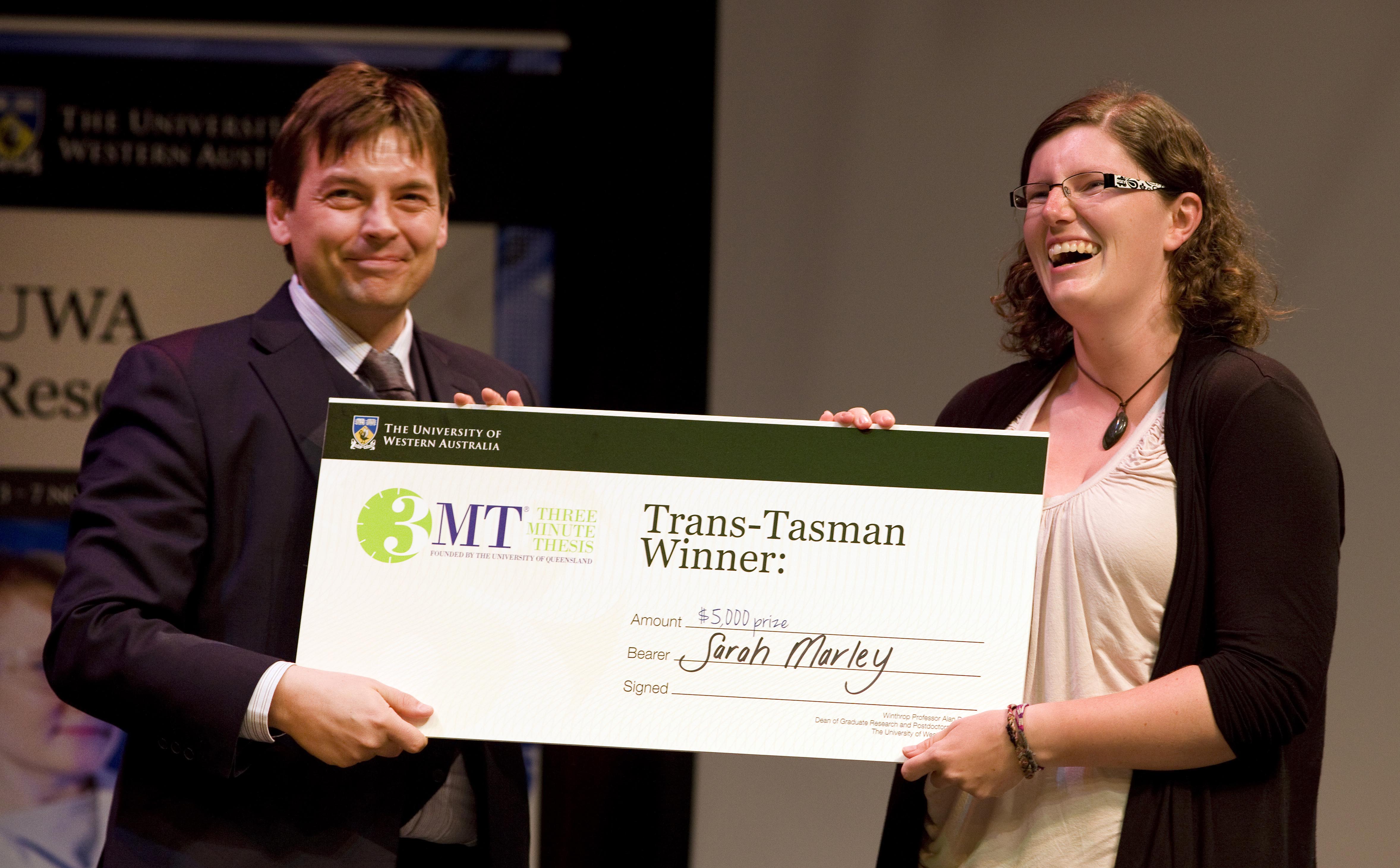
Me laughing manically as I receive my giant novelty cheque from sponsor James Mercer.  Sorry James...

Me laughing manically as I receive my giant novelty cheque from sponsor James Mercer. Sorry James…

Now all that is left is for me to thank my partner, my friends, my family, my university, the organisers, the sponsors, the judges, the competitors, the audience, the backstage staff, my high school science teacher, my pets…
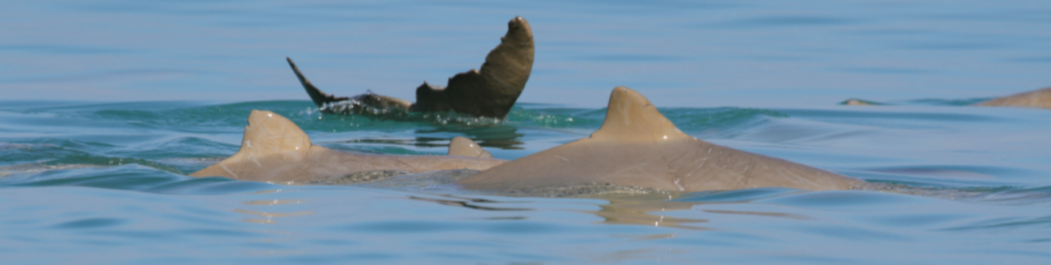
Studying Snubfins in the Kimberleys

Have you ever heard of a snubfin dolphin?  Not many people have – and up until 2005, no one had at all.

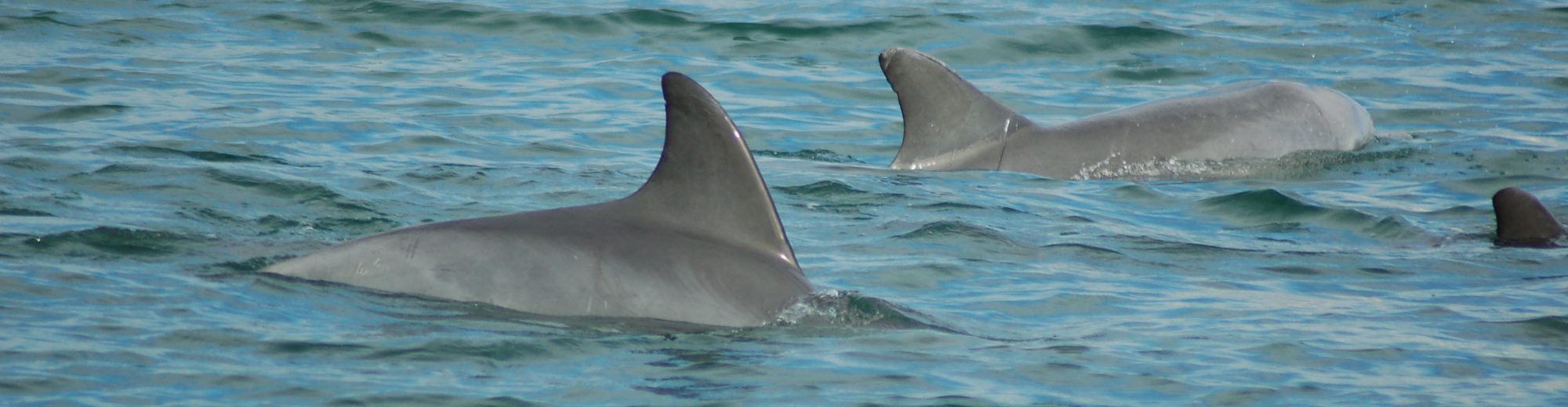
Snubfin dolphins in Roebuck Bay (Photo Credit:  Sarah Marley)

Snubfin dolphins in Roebuck Bay (Photo Credit: Sarah Marley)

In that year, what was previously considered to be a bunch of Irrawaddy dolphins swimming around off the northern coast of Australia, was discovered to actually be a separate species entirely.  And so snubfin dolphins became Australia’s first endemic species of cetacean.  But now, almost ten years later, we still don’t know a whole lot about them.

As part of the Kimberley Marine Research Program, the Western Australian Marine Science Institution (WAMSI) is funding research into the distribution, abundance and genetic connectivity of Australian snubfin and humpback dolphins across the Kimberleys.  This is a collaborative research project, involving scientists from Murdoch University, Curtin University and Australian National University.  Through a mixture of visual observations from vessel-based surveys and acoustic monitoring using underwater noise loggers, the project hopes to improve our knowledge of where and when dolphins occur.  It will also investigate the effectiveness of using noise loggers as an alternative technology for collecting data on distribution and seasonality of dolphins across the Kimberleys.

Listening for snubfin dolphins in Roebuck Bay

Listening for snubfin dolphins

During July and August this year, I was fortunate enough to be involved in the Roebuck Bay component of this project.  My supervisor Chandra and I spent a few weeks working with Dr Deb Thiele (Australia National University) to collect visual and acoustic data on the snubfin dolphins of Roebuck Bay.  It was a real pleasure to work with Deb, who has been conducting research in Roebuck Bay for several years on the abundance, habitat-use and behaviour of this snubfin dolphin population.  We were also working in with local Yawuru Indigenous Rangers Cornell and Johani, who helped us on the boat to collect observational and photographic information on the dolphins.  And to finish off our Snub-Team, we had Jason from Environs Kimberley who helped us navigate through the bay.  The Kimberleys are a stunning place in general, but it was especially great to explore it with people who know the area (and its wildlife) so well!

Over five weeks, we spent a lot of time out on the water and became familiar with a whole host of Roebuck Bay’s other marine residents.  Sightings of dugong, turtles, manta rays, sharks, sea birds, and various fish made every day unpredictable but very special!

Chandra, me and Deb

Chandra, me and Deb.

I’ve been remarkably quiet the last wee while partly because I’ve been away on fieldwork.  But also because it involved such amazing animals, cool people, and beautiful surroundings that I had no idea how to begin describing it!  A large part of PhD life revolves around stress – the pressure of making progress, meeting deadlines, producing outcomes.  But an important part of PhD life is to realise how lucky I am to have these experiences, travel to these places, and meet these people.  And this trip was definitely one of those fortunate events.

The Last 55: Final chance for Maui’s dolphins

Maui's dolphinFifty-five is not a big number.  But it could mean a world of difference to one small dolphin species in New Zealand.

Maui’s dolphin is the world’s rarest and smallest known subspecies of dolphin.  Found only in New Zealand,they typically range close to the coast in small pods although they can also be found around harbour mouths and further offshore.  But their numbers have been decreasing due to entanglement in fishing gear and disease, with approximately 4 to 5 Maui’s killed each year.  Which doesn’t seem like too many, right?

A bit of maths

In the 1970s, the dolphin population was reportedly around 1,800 individuals.  But the species has rapidly declined since net-setting and trawling were introduced in the 1970s.  A 2012 research study estimated that only 55 Maui’s dolphins now remain.  Suddenly that 4 to 5 death rate seems a lot bigger.  So just since that study was conducted, we are probably already approaching a population size of around 40 animals. Extinction isn’t just a threat – it’s a very real likelihood.

If we are losing 10% of the population each year, you don’t have to be a mathematical genius to know that things aren’t looking good for the Maui’s.  Especially given their slow reproduction rate – females reach maturity at approximately 8 years of age, and only have one calf every 2 – 4 years.

What is being done?

The New Zealand government generally has a pretty good standing when it comes to conservation.  In 2003, a ban on commercial set nets was added to an existing ban on recreational netting from north of Auckland to north of Taranaki, covering out to four nautical miles from shore.  In 2008, this was extended to seven nautical miles and in 2012 the ban on set nets extended further south.  Last year, the Minister of Conservation finalised a Maui’s Dolphin Threat Management Plan, which includes codes of practice for seismic surveys, regulations for inshore boat racing, and the establishment of a Maui’s Dolphin Research Advisory Group.

So are things improving?

Debatable. Although various marine protected areas have been created with the aim of conserving Maui’s dolphins, the government has failed to extend protections to areas where there have been credible recent sightings of the animals.  That’s the thing about marine mammal conservation – these are free-ranging animals who cover large areas in a dynamic habitat.  Thus, the distribution of populations will change over time and so needs constant re-assessment if protected areas are to have a positive effect.  But this is an investment the NZ government seems unwilling to make.

And despite several promising moves on the government’s part, it looks like money might win through in the end.  This week, it has been reported by several news groups that the West Coast North Island Marine Mammal Sanctuary – home to the Maui’s dolphin – has been signed off for oil and gas exploration.

The NZ government signed off a block offer of sea and land in April, which includes a 3,000 square kilometre overlap into the sanctuary.  Oil and gas development in this area could have a devastating impact on Maui’s habitat by increasing levels of underwater noise through seismic surveys, as well as putting the area at greater risk of oil spills.

The government has already had previous bungles with the block offer, with Simon Bridges, the Minister of Energy and Resources signing off New Zealand’s biggest forest park for drilling – despite having never heard of it.  Not exactly reassuring that the government is taking conservation seriously.

In fact, politicians are arguing whether this is even an issue, and NZ Conservation Minister Nick Smith is insisting that there hasn’t been a single observation of a Maui’s dolphin in the proposed exploration area.  So no need to worry.

But you have to wonder how hard they’ve looked?

What you can do

Numerous scientific and conservation groups have already called for the New Zealand government to take action to save the Maui’s dolphin.  Just last week, the International Whaling Commission urged the government to do more to save the species, stating that it had “extreme concern” about the decline in Maui’s dolphins.

In a recent report, the IWC estimated that Maui’s will decline to just 10 adult breeding females in six years and become functionally extinct in less than 20 years – unless their full range is protected from gillnetting and trawling.

Screen Shot 2014-05-19 at 9.15.55 amWWF have stepped up their “Last 55” campaign to save the Maui’s dolphin, urging parliament to announce permanent measures that remove fishing gear which kills dolphins and help affected fishermen adopt dolphin-friendly fishing methods.   “Anything less will not give the species a fighting chance at survival.”

Support their campaign by signing the WWF online petition here.  And hopefully we can convince the New Zealand government to stop faffing around and start taking effective steps to save the Maui’s dolphin.

The (After) Life of a Whale

Over the last few weeks, a small town in Canada has lived in fear of exploding whales.

Seriously.

A Whale of an Explosion

At the end of April, a dead blue whale washed up on the shore of Trout River, Newfoundland.  Amid concerns it could be a shipping hazard if dragged out to see, locals were forced to leave the whale decomposing on the beach whilst local and federal authorities argued over who should deal with the remains.

Inside a blue whaleThe carcass then proceeded to expand to about twice its normal size due to bloating from methane gas, a normal by-product of decomposition.  Unfortunately, there is only so far a bloated blue whale can stretch, leaving local residents on stand-by for a pretty big bang.  Strange as it sounds this is a legitimate concern – last year a washed up sperm whale in the Faroe Islands exploded as a biologist attempted to dissect it (warning:  video not for the faint-hearted).

Eventually, a team from the Royal Ontario Museum headed over to dismantle and remove the blue whale – a feat which took them almost a week.

A Sight to See (and Smell…)

Whale carcasses aren’t that great in general, regardless of their explosive potential.  A few years ago in Scotland, I took my sister to see a washed up sperm whale at our local beach.  We arrived at the car park and started walking.  When we were 1km away, she sniffed a few times and asked “What’s that smell?”.  It only got worse.

Dead sperm whale - winner of Aberdeen's Top Tourism Attraction 2009.

Dead sperm whale – winner of Aberdeen’s Top Tourism Attraction 2009.

But despite this, hundreds of people came to see it.  The carpark was overflowing for days whilst people made the trek to see the spectacle because, dead or alive, it’s just not every day you see a sperm whale.  People brought their kids (who poked it), dogs (who rolled in it), and cameras to remember the experience.

So, given the high number of marine mammals out there, why aren’t we constantly assaulted by the stink of washed-up whales?  When they’re not washing up on our beaches and becoming a gruesome attraction, what happens to the remains of whales and other marine life?  The answer:  Whale Fall.

Whale Fall

Deep-sea zones are pretty special when it comes to food-chains.  A lack of light means no plant life, which is generally the foundation of most food webs.  Instead, the deep sea ecosystem consists mostly of scavengers, who are fed from above by a constant drizzle of organic particles and detritus known as ‘marine snow’.

But every so often, a really big particle falls in the form of a whale.  And when this happens, the whole community turns up for a feast.

Recently, a deep-sea graveyard was discovered off the coast of Angola by remotely-operated vehicles (ROVs) conducting oil and gas exploration.  Consisting of a dead whale shark and four rays, this represented a surprisingly high concentration of deceased megafauna over a relativley small area.  Scientists are now using this footage to compare the species composition of scavengers on the shark and ray carcasses to the scavenger species present on whale falls.

Ecosystems within ecosystems.  A pretty cool example of how life goes on!

Fashion in the Field

Mirror mirror on the wall, who’s the fairest scientist of all…

This week I was re-reading some old Women’s Health magazines (being a student I’m too poor to buy new ones so use the oldies for fitness motivation!). I came across an article called “(Don’t) Take a Good Look at Yourself“, which was about the trend of mirror fasting. This got me thinking about the effect fieldwork can have on your appearance…

Mirror Fasting
Bloggers in the US started the craze of mirror fasting a few years ago. The idea was that by avoiding your reflection for a set period of time (generally a month), you will start to realise how much time and attention you waste worrying about your appearance. And hopefully by the end of the period, you will have weaned yourself off the need for constant visual consultation, and thus be devoting more time to other things such as relationships, career, etc.

Generally people find this pretty tough, especially with regards to hair-dressing and make-up application, combined with the fear of looking like a crazy homeless person without realising. Which is admittedly pretty concerning when you’re on your way to a big work meeting or presentation. Once on a work trip, a girlfriend and I stayed in a motel for a couple of days which didn’t have a single mirror in the unit. Each morning I would find her pressed against the side of the truck, applying her make-up in the side mirrors.

Dressing Like a Biologist

Dressing like a biologist in 2004...

From dressing like a biologist in 2004…

Several years ago, my sister told me I dressed like a biologist. I looked down at my red hoodie, baggy jeans and sneakers, and thought “Huh, I guess so!”. Fashion sense wasn’t a part of my teenage self, and it only occasionally makes an appearance even now, generally prompted by third-party advice.  Although this is partly aided by the fact we only have an above-counter bathroom mirror and a small square mirror in our house, meaning it is impossible to get a full-ensemble view without balancing on the bed and moving furniture around.

... to dressing like a biologist in 2014!

… to dressing like a biologist in 2014!

Particularly during fieldwork, comfort and practicality are my key clothing choices.  So it’s not unusual to find me rocking up to uni in between theodolite shifts rugged up in holey baggy jeans and a hoodie, with the latest addition to this ensemble is my big cosy ski jacket.  Not especially sexy, but means I don’t have to worry about wear and tear (mostly because it’s already happened…).

Looking around our office, you can usually see the distinction between desk- and field-based scientists. Pretty skirts, nice boots and proper shirts vs. fleeces, walking shoes and multiple layers. There are always a few ambiguous characters – but generally if people look surprised when you dress smart, you’re probably edging into the latter category!

Fashion Evolution

Whenever I have volunteers new to the experience of fieldwork, it’s always interesting to see how their clothing choices change over the field season.  Particularly in the summer, some of the new vollies start out pretty keen in short-shorts and strappy tops.  But after a few days of realising that it can be pretty cold early morning and that by afternoon the Australian sun is taking it’s toll, fashion choices began to edge towards knee-length pants and t-shirts.  As soon as it started edging into winter, I was busting out my scarf, ski jacket and fingerless-gloves – much to the amusement of many volunteers!  Now it’s woolly hats all round on the hill and arguments over who gets to use the one pair of gloves.

Some students are academics in the making

Some students are academics in the making

So where does this go in the long run?  I guess every university has a band of socks-and-sandals professors, but I think my career has a long way to go before that becomes a legitimate option (at this stage, even I know that’s not cool).   Last week we bought a full-length mirror, the first we’ve owned since 2011 – so perhaps a brief phase of appearance-conscious behaviour will follow!  But in the end, I’ll probably always come back to dressing like a biologist.

Well, if the (sun-smart, collar-clipped field) hat fits…

Can you be happy for 100 days in a row?

What made you happy today?

Perhaps you enjoyed a conversation with a friend, or had a really good work-out, or treated yourself to a cheeky tea and cake combo this avro!

Or maybe you are sitting there thinking back through your day and nothing springs to mind…  In which case, this could be the challenge you didn’t even know you were waiting for!

#100happydays

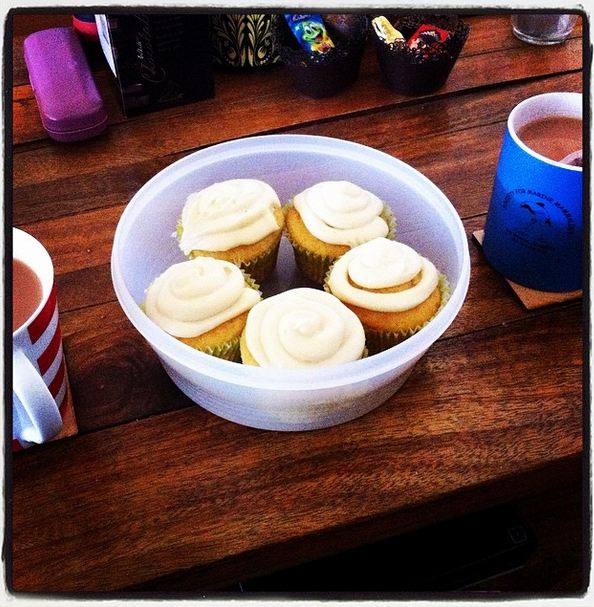
Did you find happiness in some yummy afternoon tea...

Did you find happiness in some yummy afternoon tea…

The first step to long-term happiness is finding small everyday things to be happy about.  Once you start to become more aware of the little things, they will soon add up!

The idea behind the #100happydays challenge is to take one picture each day of something that made you happy.  You can choose to post it on Facebook / Twitter / Instagram with the #100happydays hashtag, or email it into the foundation to avoid publicity, or even just keep it to yourself.  The hope is that by creating this daily ritual of stopping to share your happy moments, you will start becoming more mindful of the existence of such moments thus training yourself into the good habit of appreciating life.

Slipping into Neutral…

... or a really good workout ...

… or a really good workout …

Whenever I ask someone how their day is going, the general response is a half-shrug and an “alright”.  With our increasingly busy lives, hectic schedules, and constant rushing between activities it can be all too easy to slip into a groove.  Wake up, go to work, come home, have dinner, go to bed.  Same old, same old.

But is every day really the same?  Do you just go through the familiar motions without even a moment of happiness?  Or can you think of at least one moment today when you have a genuine smile?

If these questions are causing you any sense of doubt, perhaps it’s time to consider this challenge…

“But I don’t have time for this”

Just stop and think about this statement for a second:  you don’t have time to be happy?  Seriously?

... or maybe a care package from home?

… or maybe a care package from home?

I am pretty bad for schedule over-loading.  Between general PhD-ness, fieldwork, teaching, and general existence I find it pretty hard sometimes to keep on top of things (see an older post on the over-whale-ming side of PhD life).  Unfortunately, the first thing to suffer are the people around me, and before I know it the phrase “Sorry” is being text around several times a week along with time-related excuses.  And that is just for the locals – for my long-distance friends and family, it’s even harder as emails go weeks without a response.

This has been on my mind a lot, as my friend Janelle is submitting her PhD thesis today, and moving away from Perth next week.  We’re both aware that it’s going to become even harder to stay in touch over the coming months.  Janelle was one of the first friends I made in Australia, and I am really going to miss having her within convenient tea-and-whinging distance.  So when she suggested using the #100happydays idea as a way of keeping in touch, I was up for the challenge!

So how am I going?

See for yourself!  All my photos are available to see on my Instagram site.  I’m now up to day 20, a fifth of the way in, and even the Sceptical Scot in me can see it’s yielding results.  I’m really enjoying seeing what Janelle is up to, and having a smile over whatever has made her day!  Even though we’re in the same city, being in different universities makes day-to-day contact difficult.  But this means at least we can share the same emotion over the same event each day!

Even better, other friends are cashing in on the deal.  Over the last couple of weeks I’ve had several messages from people (both local regulars and far-away pals) saying how much they’ve enjoyed getting these snapshot glimpses into my life.  So I’m happy, Janelle’s happy, and our happiness is making other people happy.  Win!

… So I’ll ask you again.  What made YOU happy today? 🙂

Listening to the Sound of Success!

Two different projects came to fruition last week, neatly coming in time for my birthday!  Not so sure about the ageing part, but it was definitely good timing on the research outcomes!

From listening for dolphins…

Earlier this month I spent a morning out on the river with the ‘Destination WA‘ TV crew, filming a short segment about the Swan River dolphins.  We spent a lovely few hours out on the Swan River Trust boat Kwilana (Noongar for ‘dolphin’) whilst the team did interviews with myself, Delphine Chabanne (Murdoch University), Marnie Giroud (SRT), and Jennie Hunt (Dolphin Watch).

It was really interesting to see ‘behind the scenes’ for the filming process, especially given the great camaraderie of the TV crew!

… to interpreting blue whales!

Non-song vocalisations of pygmy blue whalesAnother project success last week was finding out that our paper “Non-song vocalizations of pygmy blue whales in Geographe Bay, Western Australia ” had been published online by the Journal of the Acoustical Society of America!  This study used simultaneous land-based visual observations and underwater acoustic recordings to examine the communication of pygmy blue whales.

These animals are famed for their songs, made up of repeated patterns of notes.  But in this study, we focused on the non-song sounds produced by pygmy blue whales and found six different vocalisations – five of which had never been described for this population before!  Hopefully this will help inform passive-acoustic monitoring for the species.

And as for ‘Older and Wiser’?

Well, that remains to be seen!  But entering 28 as a PhD Student, TV Star, and three-times Published Scientific Author isn’t a bad way to start 😉

Strength in Numbers – citizen science project outnumbers dolphins 28 to 1

Last week I was invited to talk at the latest Dolphin Watch training event.  Not that I need much of an excuse to talk about dolphins in general, but the chance to help introduce 180 new recruits to the Swan River dolphins was definitely not to be missed!

Background:  the Dolphin Watch project

The newest recruits of Dolphin Watch

The newest recruits of Dolphin Watch!

I’ve discussed the Dolphin Watch project in previous posts – but for those of you not in the know, Dolphin Watch is a citizen science project monitoring the dolphins inhabiting the Swan-Canning Riverpark.  It is a partnership between the Swan River Trust (SRT), Curtin University and Murdoch University which was instigated in 2009 to learn more about the bottlenose dolphins residing in the Swan and Canning Rivers.  Since this river system stretches for over 60km, it would be pretty tricky for the researchers to survey alone.  But by creating a network of citizen scientists, we now have eyes throughout the river park!

Dolphin Watch volunteers are generally people who are regular river users – whether they are kayaking up the Canning, sailing through the Swan, or just walking along the river trails!  And if they’re out by the river, then why not report the presence of dolphins?  Of course, it is just as important to know which areas the dolphins are not being sighted in.  This helps us to create a presence / absence map of dolphin sightings, and get a feel for what areas might be particularly important to this population.

Training Time!

Dr Chandra Salgado Kent explains the online monitoring form at Dolphin Watch training

Dr Chandra Salgado Kent explains the online monitoring form at Dolphin Watch training

Twice a year, Dolphin Watch runs training nights for new volunteers.  They get to hear about the purpose of the project, monitoring river health, some background to the dolphins, and how to collect sightings information.  Plus they pick up a pretty snazzy shirt and hat combo, not to mention a tote bag full of Swan River Trust goodies!

Wednesday 26th March was the first training session of 2014 down at Scitech.  Speakers included Marnie Giroud (Program Manager of the SRT’s “River Guardians” program), Dr Kerry Trayler (Principle Scientists at SRT), my supervisor Dr Chandra Salgado Kent, and Piers Higgs (Director of Gaia Resources who developed the Dolphin Watch app).  An amazing 180 new volunteers attending, bringing the total number of Dolphin Watchers to over 700 people!  With only around 25 dolphins in the riverpark, we’ve got a pretty good chance of spotting them!

And now introducing…

My role was to discuss Dolphin Ecology.  So, after a few minutes fighting with the tempremental microphone, I gave a run-down on some bottlenose dolphin life history, previous research, distribution and habitat-use, foraging ecology, and dolphin conservation.  Half an hour just flew by!  The question-time was pretty fun, with lots of good questions about dolphin behaviour 🙂

It was pretty strange being back in Scitech.  Especially doing a presentation there that didn’t involve slime, liquid nitrogen, or a single explosion!  I had quite a bit of nostalgia for the good old days of being an Outreach Science Presenter…  But at the same time, it felt fantastic to stand up and talk about something that I really cared about.  As much as I love setting myself on fire in the name of science, nothing beats talking about your own research!  Although if you have any suggestions on how I can work a fireball into a talk on dolphin ecology, please email them through! 😉

Interested in Joining?

Our next training day will be in August 2014.  If you’re keen on coming along, check out the Dolphin Watch website or shoot me an email for more information!

Fieldwork Update: Celebrating 100 hours of visual obs

Last week we passed the 100 hours milestone for visual observations in the Swan River!

"The early vollie catches the dolphin"

“The early vollie catches the dolphin”

During this first stage we have conducted 37 shifts spread across our Kings Park and Fremantle Port field sites. We spotted 16 dolphin pods, several of which had calves, with sightings lasting anywhere from a few surfacings to a few hours!

Interestingly, we have spotted Gizmo quite a few times, a dolphin who suffered a severe entanglement as a calf back in 2012. Fishing line caught around his dorsal fin cut through a lot of the tissue, leaving his fin rather floppy – and easily identifiable from a distance! Hoping we can start identifying other individuals soon in stage two!

So in summary, it’s been pretty busy!  Thankfully The Dolphineers have been there to share the load! These lovely vollies have put in a lot of time and effort in support of this project, including quite s few early mornings and long, hot afternoons! So to celebrate this milestone, last week we had our first volunteer BBQ down on the river shore.

Dolphineers

BBQ with the Dolphineers!

And, of course, for such an event there must be prizes! Drumroll please, for:

Most ShiftsLucy Rudd, for conducting almost a third of all the shifts!

Busiest DayCharlotte Patrick and Bec Oliver, for dealing with the craziest shift which had over 150 vessels in the space of 3hrs PLUS dolphins!

Most Boring DayRobin Hare, for not only having the least busiest day, but the highest consecutive number of these with no dolphins and hardly any vessels!

As we move towards April, the mornings are getting colder and the days shorter.  But we are still getting in a few new faces amonst the Dolphineers, which should liven up the shifts with some new life stories!  Now I just have to start planning prizes for the next milestone…

Over-whale-ming: Life as a PhD Double-Agent

For the last ten weeks, I have been living two lives.

Life 1: Sarah Marley, field biologist. Commences dolphin surveillance at 0500 hours, ceases observations at 1830 hours. Spends spare time managing an ever-increasing network of volunteer dolphin spies (aka “dolphineers”) to conduct regular river monitoring at select top-secret sites. She moves as a shadow, elusive of social situations, needless of sleep, as she begins the task of data hoarding…

Life 2: Sarah Marley, regular PhD student. Comes into the office a few days a week, and spends time reading papers, learning Matlab, teaching undergrads, and tackling a never-ending flow of emails. Existing mostly on caffeine and to-do lists, she has a desk-drawer full of snacks and several types of tea. Collects dolphin-themed desk decor.

Neither sound too strenuous. But recently, co-existence of these roles has become slightly tricky…

Sometimes study can be a bit over-whale-ming...

Sometimes study can be a bit over-whale-ming…

Life 1 is highly volunteer-dependent. My fieldwork needs at least a team of three (including myself), so my schedule varies each week depending on volunteer availability. I have an amazing team of dedicated, lovely, wonderful volunteers.  But – as I am trying to get out to each site 3 times per week – I inevitably have to spend a few hours trying to sign folk up to fill gaps. I live in constant fear of cancellations, and check my phone compulsively “just in case”.

Life 2 flows around the first; if I’m not in the field, I head to uni. But snatching office hours here and there can make it difficult to focus on larger tasks. As a result, when I make my weekly to-do list each Monday, I find myself re-writing the same few big jobs, along with a wave of new mini-tasks.

To try and combat this, I attended a time-management workshop last Friday. Which I was late for. But as a friend pointed out, I hadn’t attended the workshop yet so that was to be expected!  The presenter quizzed us on our degree courses, study habits, and sleep patterns. She assured me that “you only need four hours sleep to survive, so you’ll finish your PhD in no time“.  Funnily enough, this was not actually very reassuring.

Despite this we did pick up a few useful hints.  This week I have drafted up a timetable of activities based on how long each task takes.  Hopefully this will help me to use my time a bit more efficiently.  My New Years Resolution of getting a minimum of 7hrs sleep was becoming sadly neglected, so I’m also trying to “shut off” when I come home to make sure I’m rested enough to blast through those to-do lists the following morning! The ability to say “no” is something I’m working on improving.

I think the biggest challenge is accepting that there is only a given amount of things I can accomplish during the fieldwork phase.  This should only last a few more months, then there will be a seasonal down period, giving me plenty of time to tackle the desk-based stuff.

But I guess no one ever said being a Science Ninja was easy 😉