Tag Archives: Acoustics

Intro to Underwater Acoustics: Two dolphins walk into a bar…

One of the things many scientists find challenging is how to explain their research in an interesting manner.

It’s one thing preparing your research for academic publications – there is a recognised structure to follow, certain items to always include, and feedback from co-authors and reviewers to improve your writing.  But presenting that same information to the general public is a whole other ball game.  How do you keep a class of undergraduates interested for a whole 2hr lecture on underwater acoustics?  How do you encourage community volunteers to develop scientific thinking skills?  How do you explain your research to media personnel in a way that makes it exciting and worth sharing?

These are problems that I find really interesting.  Obviously traditional science communication (academic publications and presenting at scientific conferences) is important.  But I’ve spoken before of the importance of also becoming a virtual scientist, and learning new science communication techniques to promote your research.  So I was pretty chuffed last week to find myself at a day-long workshop on “Science Communication and Presentation Skills” as part of FameLab Australia.

Bringing Science into the Spotlight

Taking the Stage at FameLab Australia WA Competition

Taking the Stage at FameLab Australia WA Competition to discuss underwater acoustics

FameLab is one of the world’s leading science communication competitions.  It aims to get people “talking science” by mentoring young scientists and engineers to turn them into awesome communicators.  Similar to the 3-Minute-Thesis Competition (3MT), speakers are given only 3mins to explain their area of research – no powerpoint, no labcoats, no jargon!  Organised by the British Council, there are over 45 countries participating in the event, having their own national finals to determine their competitors for the final FameLab International Competition in the UK.

I was encouraged by Curtin University to enter, so went along last Thursday to the workshop, which culminated in the WA State Finals that evening.  The workshop was held by three local science communicators – Emma Donnelly (Science Outreach Coordinator; Curtin University), Sarah Lau (Communication Managed; ChemCentre), and Renae Sayers (Theatre and Events Coordinator; Scitech).  We spent an amazing day bouncing around between flaming hands, personal brands, communication platforms, and vocal toolboxes.  It was like a step back into my former Science Presenter life…  If I could find a way to incorporate explosions, liquid nitrogen, and / or flaming limbs into my dolphin presentations, I would be complete!

Like Taking a Keyboard from a Baby

For my talk, I really wanted to get people thinking about underwater soundscapes.  To do this, I wanted to use an example that people could relate to – and since I knew my audience would majorly consist of young to middle-aged adults, I figured comparing the underwater environment to a bar would be a pretty nifty metaphor! Almost everyone in the audience had probably experienced the masking effects of background noise in a pub at some point, so it nicely familiarised the problem faced by dolphins.

How do a keyboard and a martini glass explain underwater noise?

How do a keyboard and a martini glass explain underwater noise?

But how to illustrate this on stage?  FameLab requires the use of a prop, which I struggled with for a while.  I got a friend to record some bar sounds from his weekend exploits, but playing them on stage quickly became a logistical pain.  The rules didn’t allow me to use the FameLab sound system, and bringing my own wasn’t feasible.

But a brainwave on the treadmill (I often problem-solve whilst walking) reminded me of the last time I was babysitting.  Owen wandered over to the electric keyboard, switched it on, and pressed the ‘random filler’ option to churn out some beats before dancing around in circles for ten minutes.

Random cheesy filler music would make a great bar-sounds alternative – loud enough to make the point, whilst being tacky enough to be funny.  Win!

Two Dolphins Walk into a Bar…

The resultant talk wasn’t filmed as part of FameLab, but Phil managed to catch the talk on his phone.  The volume is a bit low, but still gives a pretty good video of my performance!
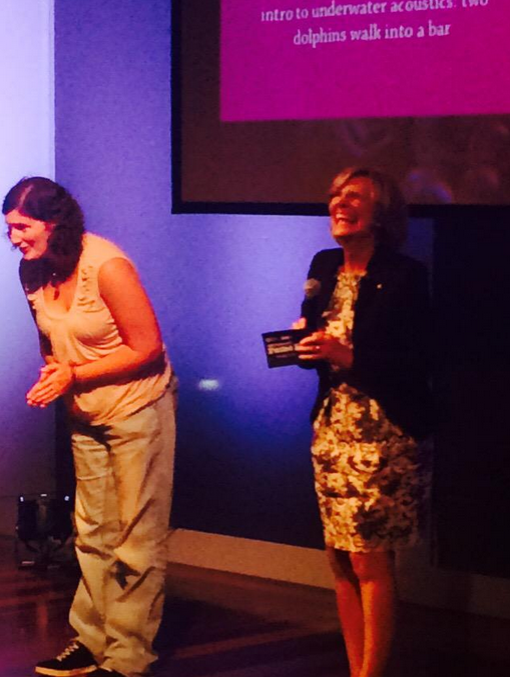
"Tursiops Wins Again!" - Lyn Beazley presents me as the FameLab WA People's Choice winner

“Tursiops Wins Again!” – Lyn Beazley presents me as the FameLab WA People’s Choice winner

I was delighted to be awarded People’s Choice by audience vote, but unfortunately I didn’t make it through to the Australian Finals.  The judges consoled me afterwards by saying that it was my lack of results rather than my performance which hindered my progression to the next round, and strongly encouraged me to come back next year.  Although, as a friend kindly pointed out, it means I got the votes of 200 audience members as opposed to 3 judges!

Regardless, I still enjoyed the whole experience!  I always enjoy the chance to talk about dolphins and get people excited in science!  And it was a wonderful opportunity to meet some fellow science enthusiasts whilst flexing my science communication skills.  Plus applause isn’t something you get often in research, so that was pretty appreciated!

A massive congrats go to Amber Beavis (WA Museum) and David Gozzard (UWA) who were the winner and runner-up for the WA competition.  I can’t wait to see you guys at the Australian final down at Fremantle in May!

Any More Talks?

But looking at the birthday card I got from the department this week, perhaps I should be focusing more on my research for a while – I appear to be getting a bit of a reputation 😛

Sarah's Birthday Card 2015

Is it a plane? A duck? A police car? No, it’s a fish…

For the last few weeks I have been working on the first chapter of my PhD describing the underwater soundscape of the Swan River.  Overall, this has been a really good way of becoming more familiar with identifying underwater sounds.  By far the most baffling of which have come from fish.

Hard-core headphones are becoming my default fashion accessory at the moment...

All about that bass: Hard-core headphones are becoming my default fashion accessory at the moment…

It turns out that many fish species produce a whole variety of ridiculous sounds, including quacks, knocks, grunts, sirens, trumpets and even Rolf Harris impersonations (sounds like his infamous wobble-board).  These sounds are all produced in different ways:  some are made using sonic muscles located on or near the swim bladder; others sounds are the result of the fish rubbing together or striking its skeletal components; and sometimes even changes in swim speed or direction can result in noise production.

But, like many animal sounds, the purpose of many fish noises is still to be determined.  Sound production might be intentional, in the form of vocalisations or calls, in which case noises are most likely signals to other animals (e.g. to attract mates, warn off competitors, co-ordinate with conspecifics, or raise the alarm about predators).  However, sounds can also be produced unintentionally as the result of feeding or swimming.  And when your subjects are mostly occurring in the cold, dark oceanic depths it can be pretty tricky to figure out the behavioural context of recorded sounds!

The majority of sounds produced by fishes are of low frequency, typically less than 1000 Hz.  By themselves they can be pretty hard to pull out of a large dataset, thus requiring a systematic search through potentially months of data.  But a really cool characteristic of some fishes is that they call in choruses.  This is when multiple (dozens or even hundreds) of individual fish within the same area produce the same call.

These choruses occur all over the Australian continental shelf, in both tropical and temperate waters and were first discovered in the late 1960s.  Many show significant seasonal trends in chorus levels and differences between years, potentially indicating that chorus activity reflects secondary productivity (see “Continental shelf fish choruses in Australian Waters” by Robert McCauley and Douglas Cato).  Others are reliably produced at specific times of year, and are believed to be associated with reproduction (see “Fish choruses from the Kimberley, seasonal and lunar links as determined by long term sea noise monitoring” by Robert McCauley), although the nature and intensity of some reproductive choruses can change in association with physical and environmental cues (see “An investigation into active and passive acoustic techniques to study aggregating fish species” by Miles Parsons).  Thus, these calls can play significant roles in the life function of many species.

Great to know that, in all these long hours you spend sitting at the computer, you are probably listening to fish sex!

Studying Snubfins in the Kimberleys

Have you ever heard of a snubfin dolphin?  Not many people have – and up until 2005, no one had at all.

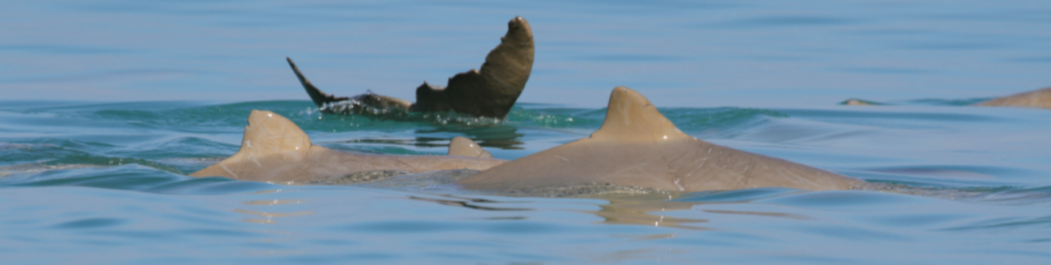
Snubfin dolphins in Roebuck Bay (Photo Credit:  Sarah Marley)

Snubfin dolphins in Roebuck Bay (Photo Credit: Sarah Marley)

In that year, what was previously considered to be a bunch of Irrawaddy dolphins swimming around off the northern coast of Australia, was discovered to actually be a separate species entirely.  And so snubfin dolphins became Australia’s first endemic species of cetacean.  But now, almost ten years later, we still don’t know a whole lot about them.

As part of the Kimberley Marine Research Program, the Western Australian Marine Science Institution (WAMSI) is funding research into the distribution, abundance and genetic connectivity of Australian snubfin and humpback dolphins across the Kimberleys.  This is a collaborative research project, involving scientists from Murdoch University, Curtin University and Australian National University.  Through a mixture of visual observations from vessel-based surveys and acoustic monitoring using underwater noise loggers, the project hopes to improve our knowledge of where and when dolphins occur.  It will also investigate the effectiveness of using noise loggers as an alternative technology for collecting data on distribution and seasonality of dolphins across the Kimberleys.

Listening for snubfin dolphins in Roebuck Bay

Listening for snubfin dolphins

During July and August this year, I was fortunate enough to be involved in the Roebuck Bay component of this project.  My supervisor Chandra and I spent a few weeks working with Dr Deb Thiele (Australia National University) to collect visual and acoustic data on the snubfin dolphins of Roebuck Bay.  It was a real pleasure to work with Deb, who has been conducting research in Roebuck Bay for several years on the abundance, habitat-use and behaviour of this snubfin dolphin population.  We were also working in with local Yawuru Indigenous Rangers Cornell and Johani, who helped us on the boat to collect observational and photographic information on the dolphins.  And to finish off our Snub-Team, we had Jason from Environs Kimberley who helped us navigate through the bay.  The Kimberleys are a stunning place in general, but it was especially great to explore it with people who know the area (and its wildlife) so well!

Over five weeks, we spent a lot of time out on the water and became familiar with a whole host of Roebuck Bay’s other marine residents.  Sightings of dugong, turtles, manta rays, sharks, sea birds, and various fish made every day unpredictable but very special!

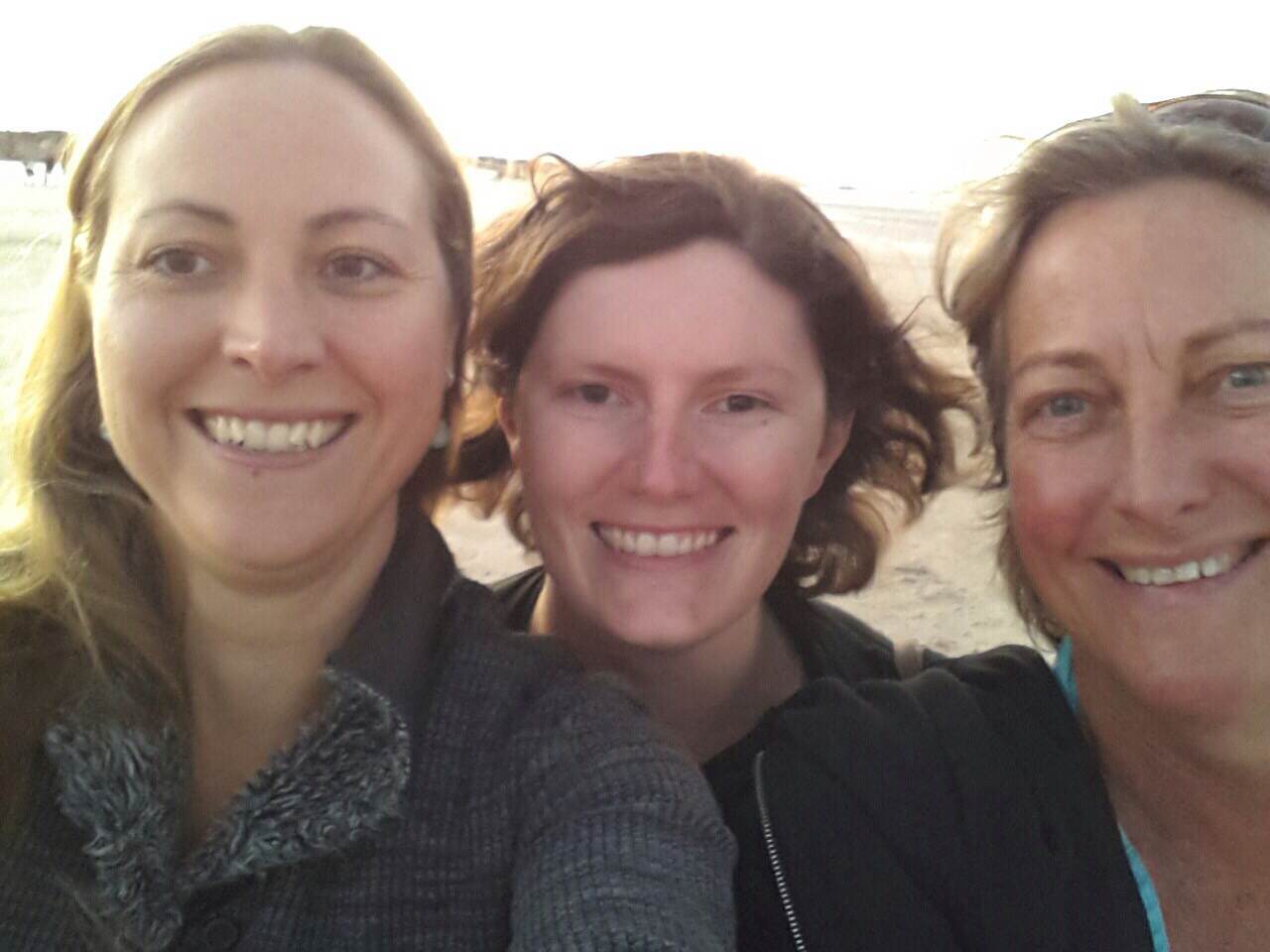
Chandra, me and Deb

Chandra, me and Deb.

I’ve been remarkably quiet the last wee while partly because I’ve been away on fieldwork.  But also because it involved such amazing animals, cool people, and beautiful surroundings that I had no idea how to begin describing it!  A large part of PhD life revolves around stress – the pressure of making progress, meeting deadlines, producing outcomes.  But an important part of PhD life is to realise how lucky I am to have these experiences, travel to these places, and meet these people.  And this trip was definitely one of those fortunate events.

Listening to the Sound of Success!

Two different projects came to fruition last week, neatly coming in time for my birthday!  Not so sure about the ageing part, but it was definitely good timing on the research outcomes!

From listening for dolphins…

Earlier this month I spent a morning out on the river with the ‘Destination WA‘ TV crew, filming a short segment about the Swan River dolphins.  We spent a lovely few hours out on the Swan River Trust boat Kwilana (Noongar for ‘dolphin’) whilst the team did interviews with myself, Delphine Chabanne (Murdoch University), Marnie Giroud (SRT), and Jennie Hunt (Dolphin Watch).

It was really interesting to see ‘behind the scenes’ for the filming process, especially given the great camaraderie of the TV crew!

… to interpreting blue whales!

Non-song vocalisations of pygmy blue whalesAnother project success last week was finding out that our paper “Non-song vocalizations of pygmy blue whales in Geographe Bay, Western Australia ” had been published online by the Journal of the Acoustical Society of America!  This study used simultaneous land-based visual observations and underwater acoustic recordings to examine the communication of pygmy blue whales.

These animals are famed for their songs, made up of repeated patterns of notes.  But in this study, we focused on the non-song sounds produced by pygmy blue whales and found six different vocalisations – five of which had never been described for this population before!  Hopefully this will help inform passive-acoustic monitoring for the species.

And as for ‘Older and Wiser’?

Well, that remains to be seen!  But entering 28 as a PhD Student, TV Star, and three-times Published Scientific Author isn’t a bad way to start 😉

Fieldwork Update: Watch out dolphins, Big Sister is watching (and listening!)

Over the last couple of months I have had a busy whirlwind of deploying noise loggers; learning how to program recording schedules and then process acoustic data; complete health and safety forms; obtain permits for area use; train volunteers for visual surveys; organise fieldwork shifts…  and this is before the fieldwork has even started!  But now it’s all underway and the data is coming in!

Eavesdropping on Dolphins…

Sylvia and Mal from CMST head out into the Swan River to help deploy my first batch of noise loggers

Sylvia and Mal (CMST) head out into the Swan River to help deploy loggers

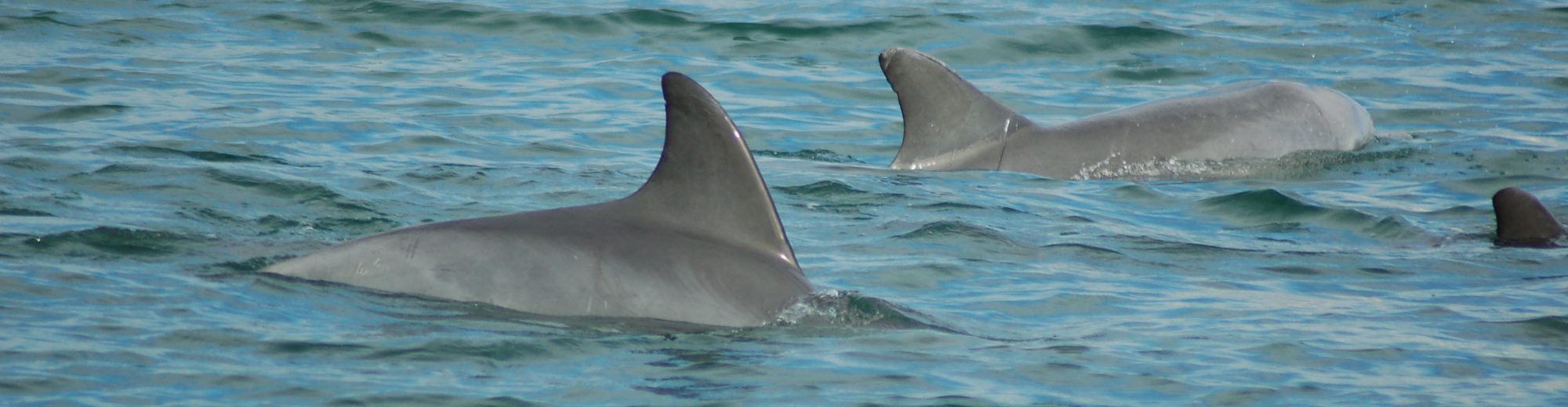
Back in November 2013, three noise loggers were deployed in the Swan River as part of my PhD project examining the acoustical and behavioural response of coastal dolphins to noisy environments.   I have been lucky enough to have great support from the students and staff at CMST to help me with deployments.  Now the first batch of acoustic data from this first logger deployment is in my office, ready for processing!

These noise loggers record underwater sound produced by ambient (wind, waves), biological (dolphins, fish, crustaceans), and human sources (vessels, traffic, and construction).  For more info on these noise loggers, see my previous post on recording whale sounds in Albany.  Whilst I am examining this first acoustic data batch, the noise loggers have been moved to new locations and are busy recording more underwater sounds.

Over the next year, I will be deploying noise loggers at several spots throughout the river.  I can then use these data to describe the underwater soundscape of the Swan River and examine the vocal behaviour of bottlenose dolphins.

…  Whilst Watching from Above!

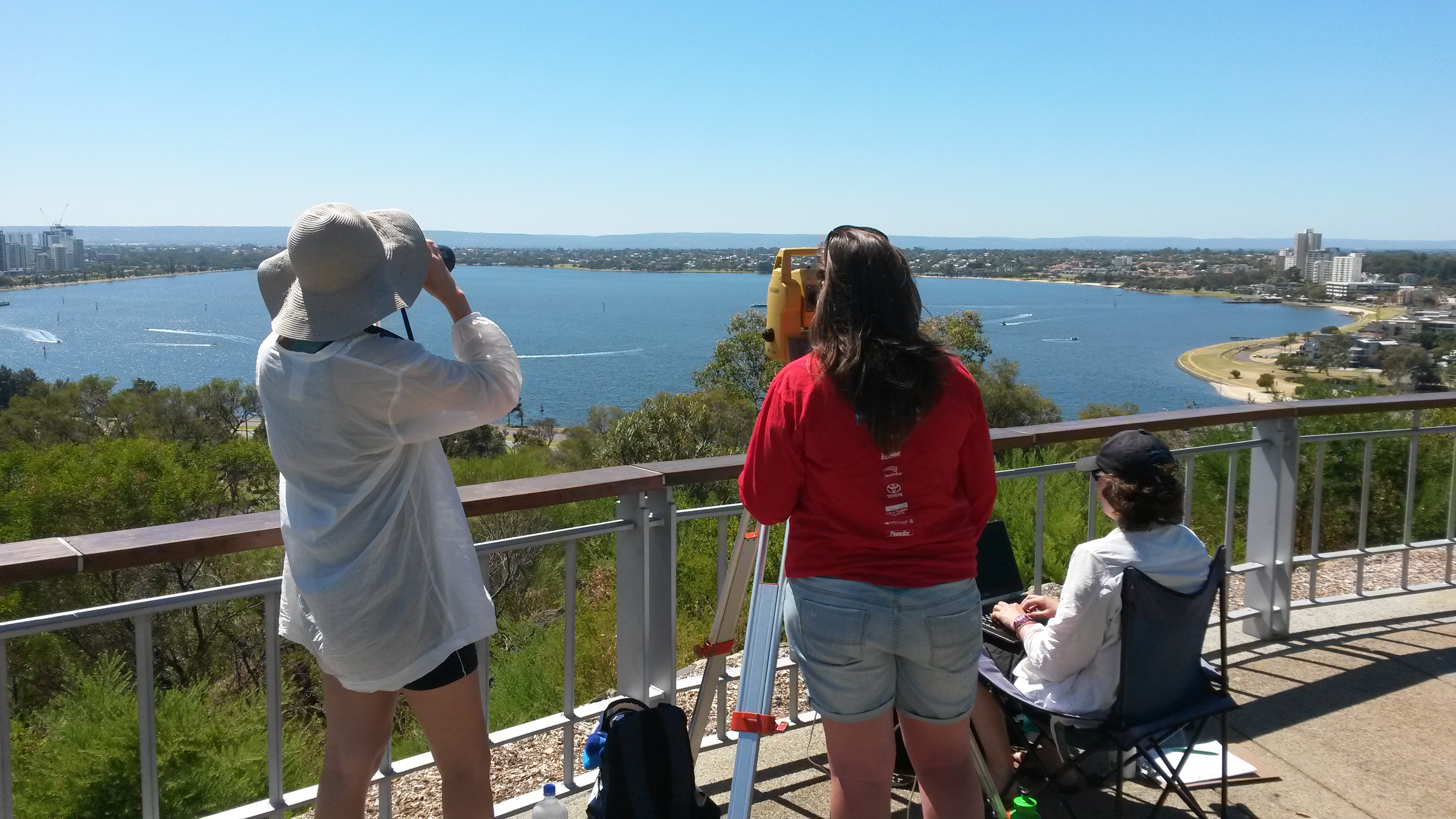
Visual observations of dolphin behaviour began in January 2014.  I am conducting visual surveys at various vantage points along the shoreline, using a theodolite to record dolphin movements and behaviours in the river.  This visual information can then be used to understand the context of dolphin sounds and their use of the underwater acoustic environment.

A theodolite is traditionally a surveying instrument, used to create 3D models of the landscape.  It does this by selecting different points, then measuring the horizontal and vertical angles to give an exact bearing and distance to each point; this creates a scale map of the area.  But we can also use this technique to get the position of objects out at sea – such as dolphins!  So we can use a theodolite to map a dolphin’s position each time it surfaces, giving a very fine-scale track of how the animals are using an area.  The added bonus being that the dolphins are not aware of our presence, so we do not have to worry about disturbing the animals and influencing their behaviour.  Although I do often wonder if they have a “feeling of being watched”…

Volunteers Elly and Bec join me surveying for dolphins in the Swan River

Volunteers Elly and Bec join me (and theo) surveying for dolphins in the Swan River

To run these visual surveys, I require a theodolite team:  one person entering data on the computer, one collecting positions using the theodolite, and some others to find the dolphins!  Thankfully, I have had an overwhelming amount of support from my ex-students (and some marine biologist friends), and currently have around 25 volunteers donating their time to help out in the field.  Many are studying or working full-time, making their contributions all the more amazing and appreciated!

But we have had some particularly awesome dolphin sightings to make it all worthwhile – and even on quiet days, the great team spirit (and masses of life stories to tell) keeps us pretty entertained!